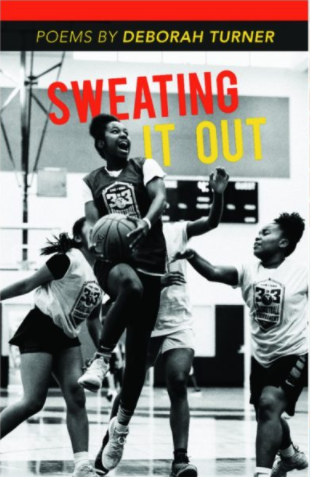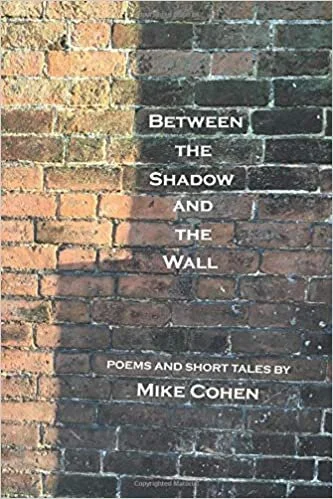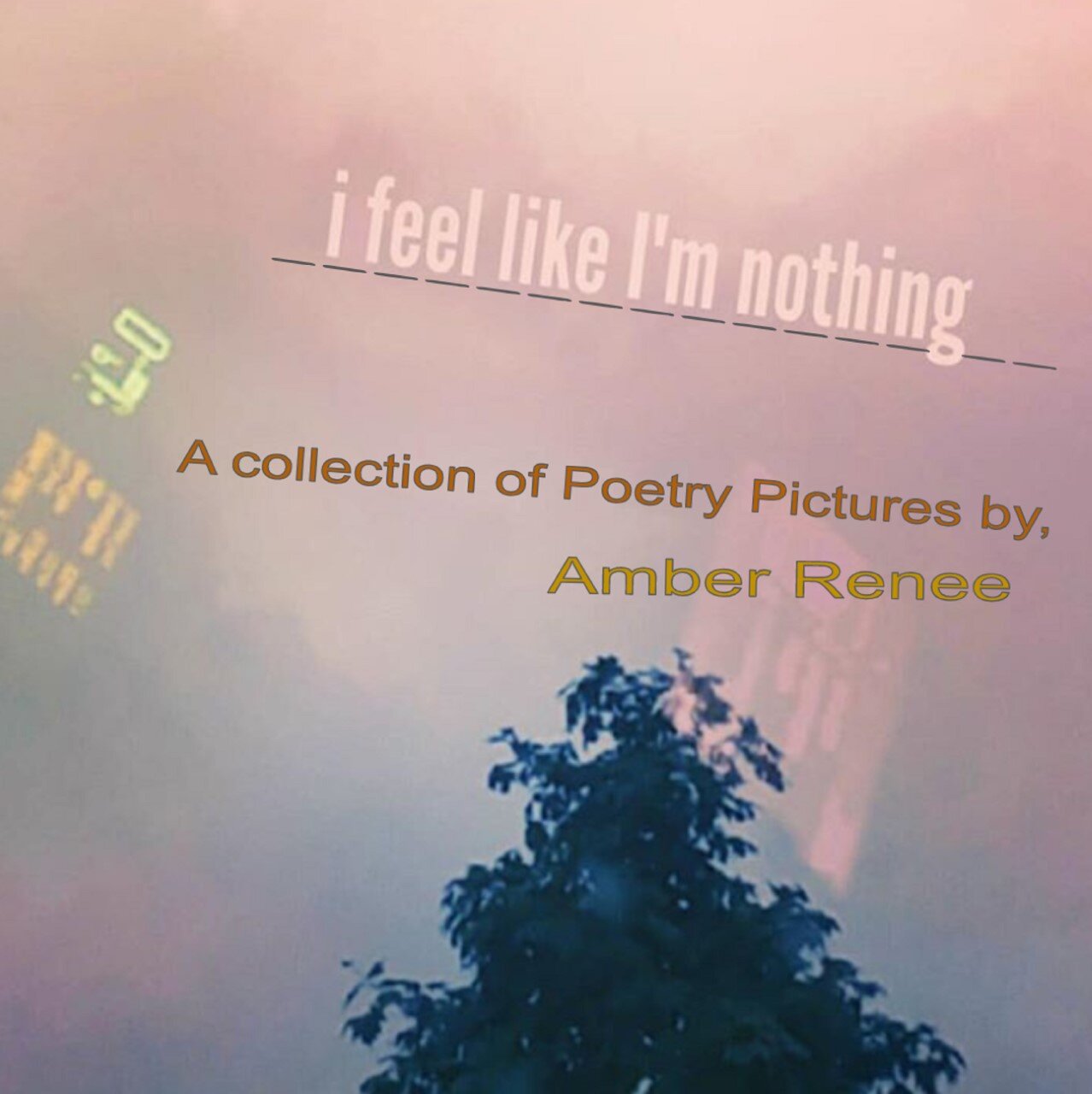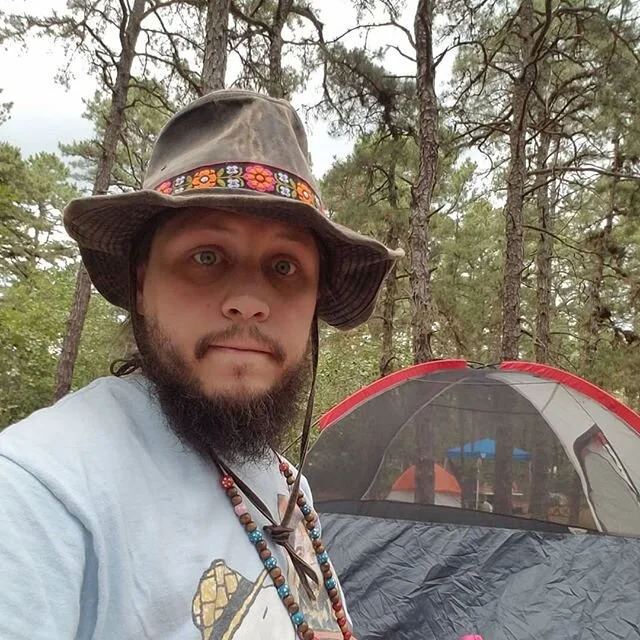
Profession: Poet

Profession: Poet

February 9, 2021

Profession: Poet is a new monthly blog feature exploring craft and identity in poetry by Hanoch Guy, who writes poems in both English and Hebrew.

SUBMISSIONS, REJECTIONS

Take a moment to think about your submissions process.

What do you think and feel about poetry submissions?

A waste of time.

Intimidating.

Slim chance of acceptance.

Worth a try.

Where do I start?

 Throughout my career, I have been convinced that submission of my work is essential to me as a poet.

 There is no great benefit to pursue a consistent submission stream.

 *

 I’d like to offer my own experience.

 On July 1, 2016, I had the crazy idea of giving myself a challenge to send 100 submissions  in 100 days.

 I completed it.

 Here are the results:

  •  42 rejections

  • 35 acceptances

  • 23 no responses

 At the end of the challenge, I was exhausted. During the experiment, I was not able to do anything else.

 When I expressed my disappointment to a fellow poet, he assured me that that was a very good outcome.

 My rules for submissions are:

  •  I aim to send to magazines that respond within 3–4 months.

  •  I read poems in recent issues of magazines I am interested in to get an idea of what they publish.

  •  I only submit to magazines online that may have a print issue.

  •  I usually submit to calls for a group of themed poems.

  •  When I get a rejection, I send the poem to another magazine the same day.

 *

 Consider that most magazines have a staff of only two or three people, so expect a short form letter and don’t expect feedback.

 In all the years I’ve been sending out poetry, I have received only two letters of positive feedback and two negative ones.

 Bottom line: How should you submit?

It is clear that submitting is hard work and very time-consuming.

If you do online searches, you will find out, as I did, that it can be a long and drawn-out process.

In general, you should look for places that publish poets you admire. It is a good guideline to submit to places that align with your type of poetry, with your style and aesthetic, and places where you think your poems would be at home.

Here are some of the resources that may make your submission process more efficient and focused, although these will also be time-consuming and take some dedicated research.

Poet’s Market is like Old Faithful and has been published for about thirty years. It is the most trusted guide to publishing poetry. Want to get your poetry published? There’s no better tool for making it happen than Poet’s Market, which includes hundreds of publishing opportunities specifically for poets, including listings for book publishers, publications, contests, and submission preferences.  

Poet’s Market also has articles devoted to the craft and business of poetry, featuring advice on the art of finishing a poem, advice for putting together a book of a poetry, promotions, and more. You’ll also gain access to a one-year subscription to the poetry-related information and listings on WritersMarket.com, lists of conferences, workshops, organizations, and grants, and a free digital download of Writer’s Yearbook, featuring exclusive access to the webinar “Creative Ways to Promote Your Poetry.”

Another good resource is Poetry Markets, where you can find places to submit whether you are a beginner or a seasoned poet.

Another source for poetry information is Poetry Super Highway.

My favorite local place to submit is Philadelphia Poets, edited by Rosemary Cappello, who is very generous with her feedback and hosts an annual reading that follows the yearly publication of the print issue.

An instructor once told me, “Unless your floor is littered with submissions and rejections, you did not do the job.”

What do you think?     

I wish you good luck in your submissions.

Please share your experiences of submissions and rejections in the comments section.
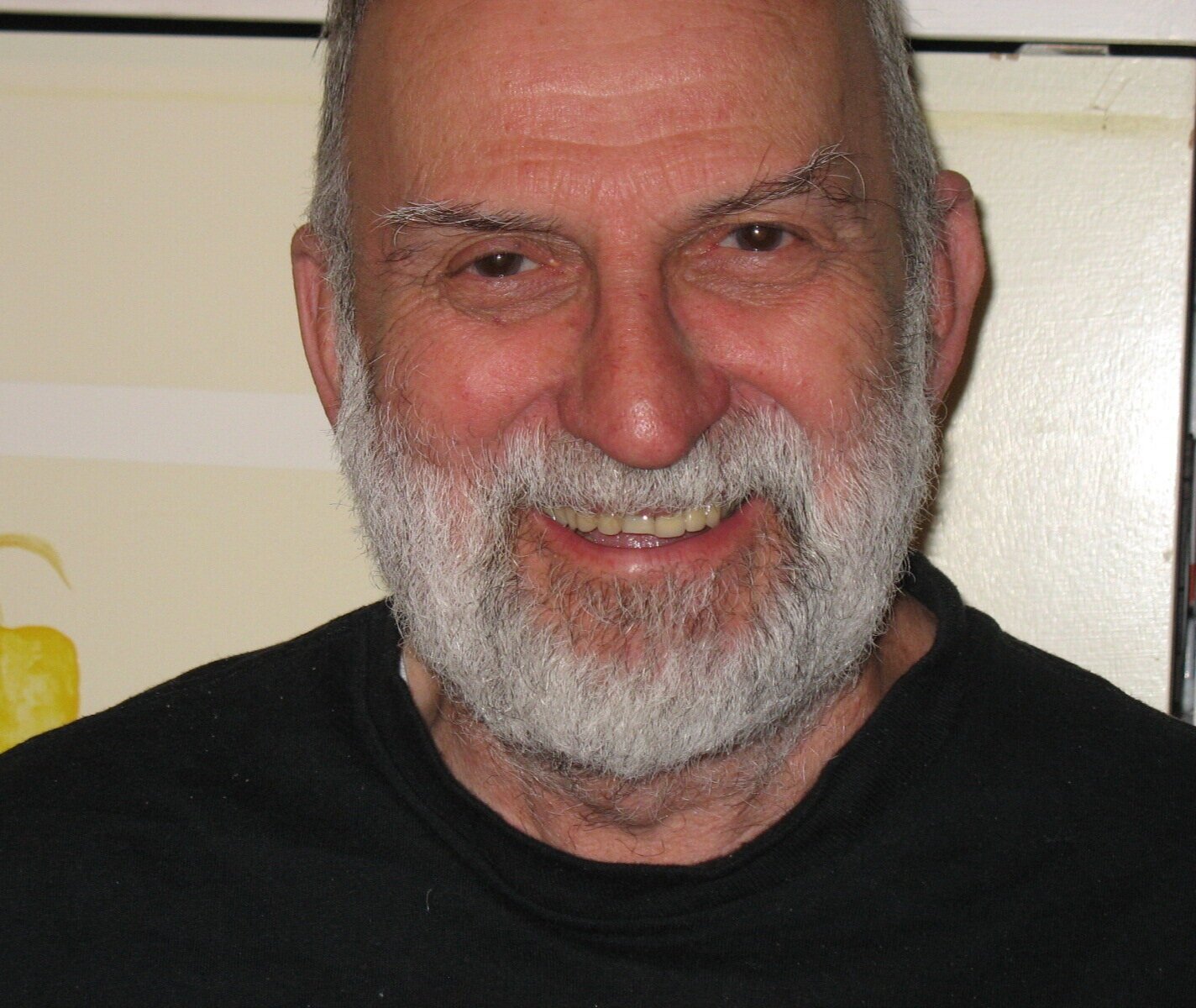

Hanoch+Guy.jpg

Hanoch Guy Ph.D, Ed.D spent his childhood and youth in Israel. He is a bilingual poet in Hebrew and English. Hanoch has taught Jewish Hebrew literature at Temple University and poetry and mentoring at the Muse House Center. He won awards in the Mad Poets Society, Phila Poets, Poetry Super Highway and first prize in the Better than Starbucks haiku contest. His book, Terra Treblinka, is a finalist in the North Book Contest. Hanoch published poems in England, Wales, Israel, the U.S., and Greece. He is the author of nine poetry collections in English and one Hebrew book.
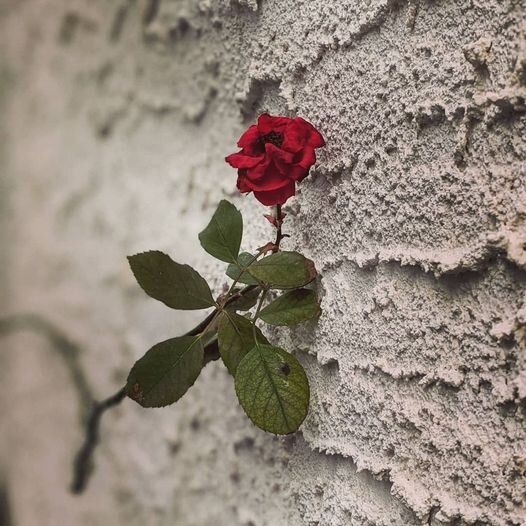
POeT SHOTS - '"The Rose that Grew from Concrete " by Tupac Shakur

POeT SHOTS is a monthly series published on the first Monday of the month. It features work by established writers followed by commentary and insight by The Mad Blogger, a mysterious figure who is in love with poetry and the power of the written word.

Image credit: Philip Dykhouse

Image credit: Philip Dykhouse

The Rose that Grew from Concrete

by Tupac Shakur

Did you hear about the rose that grew
from a crack in the concrete?
Proving nature's law is wrong it
learned to walk without having feet.
Funny it seems, but by keeping its dreams,
it learned to breathe fresh air.
Long live the rose that grew from concrete
when no one else ever cared.


On January 20th, at the presidential inauguration, we all saw the true power of poetry. It has the power to bring us together, to inspire us to be better than we were, and it can show us that, despite all the odds and adversity, we can be great. There has been a long tradition of poetry written to help people see their own worth and potential. One such poem is “The Rose that Grew From Concrete,” the title poem from Tupac Shakur’s post-humous collection of his poetry. In this poem we see Shakur’s belief that everyone is capable of making something of themselves.

The poem itself is delicately crafted, so much so that removing a single line or image would make the whole thing shatter. Without ever mentioning them, the poem addresses racism, poverty, and Shakur’s own personal struggles. In lines like, “[p]roving nature’s law is wrong,” and, “when no one else ever cared,” we see the oppression and inequality, but also indifference, a world that doesn’t care about Shakur because of who he is and where he is from. But ultimately, despite these odds, the rose, “learned to walk with out having feet,” and, never forgetting its dreams, “learned to breathe the fresh air.” The word never mentioned here is hope, but it is everywhere in this poem, the hope of a better future, and of rising above the limits society places on us.

 Poems like this challenge us. They force us to look inward. As readers and lovers of poetry, it makes us question why we read it. But as writers, it forces us to ask ourselves, “why do we write?” Do we write merely for the validation that comes from being published? Do we write so that we can be critically praised and honored? Or do we write to change people’s lives? Do we write to help others see the beauty of hope around us, no matter how ugly the world gets? Words have power. Poetry has power. How do we intend to use it?           

What does this poem say to you? How does it inspire you? Let us know in the comments.


The Mad Blogger is dedicated to showing that poetry is not some mystery. There are no right or wrong ways to read poetry; it is for everyone to read, understand and enjoy. The Mad Blogger is all of us and none of us. As long as people still believe in the power of the written word, The Mad Blogger will be there, providing insight, perspective, and (hopefully) inspiration.

Source: POeT Shots: The Rose that Grew from ...

Review of Ben Saff's minor league all american dance club

Review of Ben Saff's minor league all american dance club

January 27, 2021

minor league all american dance club.PNG

minor league all american dance club

Toho Publishing

$9.99

You can purchase a copy from Toho Publishing or Amazon.

Reviewed by Chris Kaiser


“Perhaps I know best why man is the only animal that laughs: he alone suffers so excruciatingly that he was compelled to invent laughter.”

Frederick Nietzsche


Is it any wonder millennials are attracted to the absurd? They are told to go to college, which saddles them with debt and offers few job prospects, forcing them into the tenuous gig economy that proffers no healthcare insurance, no paid vacation, and no job security. In the meantime, they are fed a steady diet of American optimism by the powers that be. They are told the country is in good shape because the stock market is performing well, while unemployment is at an all-time high. They are told the military is the best in the world even though the U.S. lost in Korea and Vietnam, and has been mired in conflict in Afghanistan and Iraq since 2002. And they were told that the novel coronavirus would disappear like a miracle.

 Albert Camus asked the question: “How does a rational being confront the idea that his existence might not be rational but rather absurd? The answer,” he said, “is simply to laugh.”

 Absurdist humor relies on the illogical, the incongruous and it is alive and well among the young adult demographic. It helps to express the disillusionment felt by many millennials.

Yet, the absurdist humor in millennial Ben Saff’s new chapbook, minor league all american dance club, isn’t so much about disillusionment, as it is about having fun. And fun is what I want right now, given recent political events.

Absurdist humor breaks rules and Saff does that with talking alligators, observant parking meters, and passengers tip-toeing on the wings of airplanes. The opening poem, “the alligators,” seems to be a simple tale of alligators strutting around the city like “they were born here,” enjoying themselves at comedy clubs, and smoking in cafes. But like all good poetry, Saff leaves a lot of room for the reader to ask questions and fill in the blanks. Where did the alligators come from? Why did they travel north? Did they not feel as powerful in their previous geography like they do in their new environs? Why is it important we know what makes these alligators laugh? The poem is less than 20 lines long, yet packs an emotional punch that is both unassuming and potent.

I am familiar with the conspiracy theory that purports a secret cabal of reptilian shape-shifters controls the world. Is Saff playing with this idea? I don’t want to give away the poem, but I will repeat the warning of the poet: “don’t ask what’s in their briefcase.”

Another poem titled “roommate” plays with our absurd sensibilities. The narrator encounters death, who “drums a rhythm / on the wall” with his scythe, and also plays air guitar on it. But this is not the first time our narrator has seen death. We are told that death loves the trick of “passing / through the locked apartment door,” but that it’s “getting old”. I can just imagine the grim reaper trying to get a laugh from his bored roommate.

Death makes himself at home, talking about his foray into yoga (he “won’t shut up about it”) and smiling at the suggestion to “order dominoes”. The whole scenario is bizarre and absurd, but somehow believable within the context of the world Saff creates, told in a simple, readable fashion.

I recently attended a graveside service for a 40-year-old man who died of a drug overdose. During the ritual, I sort of had my own conversation with death, thinking about how I should perhaps prepare for his arrival. I might have been better served psychologically if I had entertained the notion of death more absurdly, like Saff. After all, no one escapes the final breath. Why not room with death, get to know his annoying habits, and discover what makes him happy?

Humans have an inherent longing for certainty, which can manifest in many ways, some of them harmful like authoritarian cults or fascist governments, some of them harmless like marriage and ritualistic routines. Humor is one way to combat uncertainty and the poet shares the stage with the philosopher and the comedian in helping us share in the laughter rather than fight in the despair.

In the poem “angel gabriel,” Saff again challenges our funny bone by having “angel gabriel … shop at target.” As Saff has done with just about all the poems in this collection of 19, he leaves lots of room for the reader to travel within the poem to find several layers of meaning. At first, the reader might think this poem is about the Angel Gabriel, the one who foretold the birth of John the Baptist and Jesus. But there is some wiggle room in that interpretation. Saff never uses the definite article “the” before the name angel gabriel. It could actually be the name of an Hispanic character. Another clue to the latter interpretation is the use of the Spanish phrase, “piso mojado” (wet floor) on a “a bright yellow sign” that angel gabriel passes.

Just when the reader thinks he or she might have the poem figured out, or at least manageable, Saff tells us that angel gabriel stopped himself from buying a succulent plant when “he remembers the fifth / commandment.” That line just turned my world upside-down. It was so unexpected and it gives the poem extra layers for interpretation (or just enjoyment).

I’m aware of the irony of trying to explain these works when absurdity is the compulsion to go looking for meaning that simply isn’t there.

Some of the poems in this collection — and especially “miata” — remind me of the poem, “A True Account of Talking to the Sun at Fire Island,” by Frank O'Hara, which just so happens to be one of Saff’s favorite poems. “This poem has so much of what I enjoy about poetry: it's lawless, imaginative, playful, absurd, authentic, and just a little bit enlightening,” Saff told me in an email.

And those are all the qualities you’ll find in the poems in this marvelous chapbook. You will laugh, you will be surprised, you will want more.

Chris Kaiser.jpg

Chris Kaiser’s poetry has been published in Eastern Iowa Review, Better Than Starbucks, and The Scriblerus. It appeared in Action Moves People United, a music and spoken word project partnered with the United Nations, as well as in the DaVinci Art Alliance’s Artist, Reader, Writer exhibit, which pairs visual art with the written word. He’s won awards for journalism and erotic writing, holds an MA in theatre, and lives in suburban Philadelphia.

Mad Poet of the Year - Ray Greenblatt (January 2021)

The Mad Poet of the Year blog posts share the poetry of a long-time Mad Poet. This year-long appointment provides readers with a deep dive of the writer’s work and thoughts on poetry. We are thrilled to have Ray Greenblatt serve as the inaugural Mad Poet of the Year for 2021.


VENICE SUBMERGED

 by Ray Greenblatt

Only the tourists care now
donning scuba gear to sink into
to sink back into this womb of a world
into waters where pollution has been swept away
by this whirling locus of West meeting East;
though the manifold portraits in palazzos are gone
their spirits have been set free
by the purifying waters;
past the arcades and screens of the Doge’s palace
gilt altarpieces now shipwrecks gathering barnacles
over and under bridges they flutter
coral resembling lemon and olive trees
canals so many racing lanes;
they swim like the naked cherubs in the still spouting fountains
float over the gleaming dome of Saint Marks
and a winged lion perched on a pole
the pigeons transformed into sole.

The scuba men pass Harry’s Bar
where Hemingway in perennial safari outfit
swaps conceits with scarlet-lipped Baron Corvo;
they can still hear arias of gondoliers
and Browning at his toccata;
past Byron swimming tipsily home
and Diaghilev jetting by
past Thomas Mann who still imagines
he is judging the boy with tightest well-turned rump
and penis non-threateningly petit
past priests their black cassocks spread like manta rays;
some divers search for a legendary air pocket
in which a coifed harlot might lie;
humans can not breathe in water, we are told,
but if they could sidestroke this one minor rule
they could inhale, indeed could ingest the living past.


Venice is an ancient, beautiful, mysterious city. It has always had flooding problems. What if it was completely inundated, like Atlantis! Since this is a poem, I also wanted to include other authors who have had connections with this magical city.


Ray Greenblatt.jpeg

Ray Greenblatt has been a poet for forty years and an English teacher longer than that. He was an editor of General Eclectic, a board member of the Philadelphia Writers Conference, and is presently on the staff of the Schuylkill Valley Journal. He has won the Full Moon Poetry Contest, the Mad Poets Annual Contest, and twice won the Anthony Byrne Annual Contest for Irish Poetry sponsored by The Irish Edition. His poetry has been translated into Gaelic, Polish, Greek and Japanese.

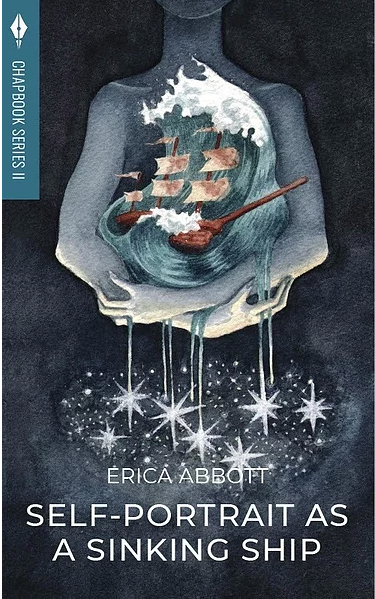
Review of Erica Abbott's Self Portrait as a Sinking Ship

Review of Erica Abbott’s Self-Portrait as a Sinking Ship

January 20, 2021

Self-Portrait as a Sinking Ship.PNG

Self-Portrait as a Sinking Ship

Toho Publishing

$12.00

You can purchase a copy here.

Reviewed by Sean Hanrahan


Every poetry reader can remember the rare moments when they were struck by unrelenting honesty in verse, especially when it is paired with lyrical imagery and thoughtful flashes of insight and wit. I believe when a poetry reader picks up Erica Abbott’s Self-Portrait as a Sinking Ship they will have several of those moments.

Abbott shows remarkable honesty early on in her debut chapbook with the poem, “10 Things You Should Know About Mental Illness.” She writes “Don’t stand too close/ because even though I won’t mean to hurt you,/ I will. You must learn to look past the sparkle.” This poem, featured in the half of the book aptly titled “Darkness,” pulls no punches as the narrator describes to her loved ones her struggles, her fears, her experience with mental illness. In the vein of successful confessional and lyric poets, Abbott deftly interweaves nature imagery to serve as a landscape for the narrator’s emotions:

It crashes into me like a wave, knocking me down
and threatening to drown me if I’m not careful.
But I didn’t know I was standing in the ocean,
even as it foamed at my feet. The salt no longer
stings the wounds; it just makes them bleed more. I
don’t notice the seas redden.

Nature imagery recurs quite frequently in this chapbook. In the closing poem contained in the second half of the book titled “Hope,” Abbott instructs us “How to Stargaze Through the Light Pollution.” At first, it appears we can only see the stars through artificial means: downloading a “star finder app” or “phosphorescent star stickers.” Frustrated at light pollution, like so many of us stargazers, she exclaims we should “[t]urn off every light in this city. No—/ to hell with that—make it the world.” After that event, “[b]illions of people will…cry as the cosmos opens up before them.” Like all true poets, Abbott knows that there is at least one more thing important than nature, and that is love. In her fifth and final instruction, she writes

Gaze into the eyes
of your lover. Lose yourself
in every shooting star and supernova
lighting up your face. This is how
you rediscover the universe.

Abbott deploys strategic flashes of insight and wit in the poem, “St. Ends, Patron Saint of Endings.” In this narrative poem, she writes about a broken friendship and “Best Friends” necklace where “the side I kept reads: st ends.” The narrator relays the universal and painful experience of friends drifting apart after attending different schools where they never find that same true friendship again. She writes, “[w']e walk into different rooms where the only/ people who know our names are those with an/ attendance sheet.” She chides herself for not reaching out to her distant friend:

.And I think how very fitting it is to be the patron
saint of endings.
Why can’t I just pick up the phone, say hello—
how have you been?

Relationships are a central theme in Self-Portrait as a Sinking Ship. In perhaps the most luminous poem from the “Hope” section, Abbott compares her romantic relationship to “Light in the Fog:”

I’ve always loved the way the light
interacts with fog—
the way it filters through like
moonlight on a cobweb.

This tender poem uses lush language to express her love and helps to give this sterling chapbook a welcome roundness of darkness and hope, of pain and love. Whether reading it silently or aloud, by yourself or with a loved one, Self-Portrait as a Sinking Ship will break your heart and mend it again. It will blow you away with its poignancy and grace. Abbott shows wisdom and lyrical grace that belies the fact that this is her debut work. Expect more to come from this dedicated, already very talented, poet.


Hanrahan+headshot.jpg

Sean Hanrahan is a Philadelphian poet originally hailing from Dale City, Virginia. He is the author of the full-length collection Safer Behind Popcorn (read review here) (2019 Cajun Mutt Press) and the chapbooks Hardened Eyes on the Scan (2018 Moonstone Press) and Gay Cake (2020 Toho). He is currently at work on several literary projects as well as teaching a chapbook class. He currently serves on the Moonstone Press Editorial Board, is head poetry editor for Toho, and is workshop instructor for Green Street Poetry.

Local Lyrics - Featuring Alison Lubar

alison lubar.jpg

Conservation of Matter
By Alison Lubar

(first published in Apiary Magazine, Issue 11)

No carbon decomposes. I recycle [not-love,
repurpose] crumbling brick to garden path,
replace pious copper pipe Cowith plastic. [Which
of twelve steps compels benedictions?] Spackle
holey walls’ fist-divot, cover couch in navy velvet
and linen pillows, banish tobacco tins and empty
fifths of whiskey [hidden behind cookbooks
or bedside table]. The next era built with Good
Will and wish: resourceful as neighborhood
pigeon who [nests with fishing line, dental floss,
paper straw wrapper, matted spiral of white hair]
makes home from nothing [everything].


You are a teacher as well as a poet. Does teaching influence your writing or perceptions of writing? You are also a yoga instructor. Do poetry and yoga intersect for you?

Teaching has definitely influenced my perception of writing-- as a student, school was the first place where I really started to share my writing. I won a poetry contest in first grade and read my entry on the morning announcements. I always loved reading poetry, and found teaching it just as wonderful. In the best of times, I feel like a poetry clinician for my students. Heartbreak? I’ve got a poem for that. Rough day? Have one for that too! Teenage blues? Oh there are so many to recommend… And for those of my kiddos who hate poetry, I challenge myself (and them) to find something that they dislike the least.

 As an adult, I really started seriously writing after completing a yoga teacher training for a kids’ yoga program. At the end of the program, we were asked to write words on post-its that made us think of the other participants, and someone put “poet” on my left shoulder. I spent the next several months in a longer YTT program, and that just helped open the figurative heart valve. They’re definitely connected, because they both involve the whole self, in both whatever and every ontology one might ascribe to.

It’s a small thing but I love that you effectively utilize square brackets in your poetry. How do they inform your poetic voice?

Thank you! My drafting style is [incredibly] voluminous. I really work to pare down long lists of images and words, and some find their way into brackets. I always wrote with parentheses (even in high school papers), and the use of such insertions/mini-digressions really speaks to the way that I think.

From what I have read of your work, your poems are often driven by fresh and surprising images. What’s your strategy for cultivating poetic imagery that both startles and satisfies?

Startles and satisfies! I love that. When I’m trying to describe a thought/experience/thing, I attempt to hold it up to different lights, palm it, and turn it in my hand. I think of Rita Dove’s finesse in “Flirtation,” or when I’m driving, I’ll try to come up with different ways to explain what I see. Could telephone poles be eyelashes? Can double yellow lines be luminous? I love playing with sounds and pure phonetics, then try to make some sense out of what’s emerged-- syntax first sometimes, then semantics. 

Virtual poetry readings and journal launches have emerged out of necessity due to the current pandemic. What has your experience been like engaging with poetry virtually?

Oh, I have found such an incredibly talented and loving community. Multiple communities, really. I’m stranded in NJ right now and had every intention of moving to Philadelphia, BC (Before Covid). I attend weekly sit & writes and have connected with so many other writers in Philadelphia and beyond. Where I wouldn’t normally be able to attend an event or workshop because of location, I now can. I think it’s an important time for poetry, but really, the time is always right, right? I love seeing familiar faces at readings and have really made some important connections & friendships over the virtual verse universe.

 Where can readers find more of your work? Buy your book?

I’m working on a second chap while my first is (still) out for submission! My website is www.alisonlubar.com, and you can find me on Twitter and IG @theoriginalison. I’ve recently had work in Apiary Magazine and antonym lit. Both are beautiful, digital issues. And I’ll hopefully send you some chap or collection news soon!


bwbeach.jpg

Alison Lubar teaches high school English by day and yoga by night. They are a queer femme of color whose life work (aside from wordsmithing) has evolved into bringing mindfulness practices, and sometimes even poetry, to young people.  Most recently, their work has been published by or appeared in Rowan University’s Glassworks, Giovanni’s Room anthology queerbook, Fearsome Critters' Quaranzine, Apiary Magazine, and antonym lit.


wojto.jpg

Catfish” John Wojtowicz grew up working on his family’s azalea and rhododendron nursery in the backwoods of what Ginsberg dubbed “nowhere Zen New Jersey.” Currently, he works as a licensed social worker and adjunct professor. He has been featured in the Philadelphia based Moonstone Poetry series, West-Chester based Livin’ on Luck, Mad Poets Society, and Rowan University’s Writer’s Roundtable on 89.7 WGLS-FM. Find out more at: www.catfishjohnpoetry.com.


Review of Leonard Gontarek’s The Paris Poems Of Jim Morrison

Review of Leonard Gontarek’s The Paris Poems Of Jim Morrison

January 13, 2021

thumbnail_Paris Poems Cover.png

The Paris Poems Of Jim Morrison

Moonstone Press

$10.00

You can purchase a copy here.

Reviewed by Abbey J. Porter


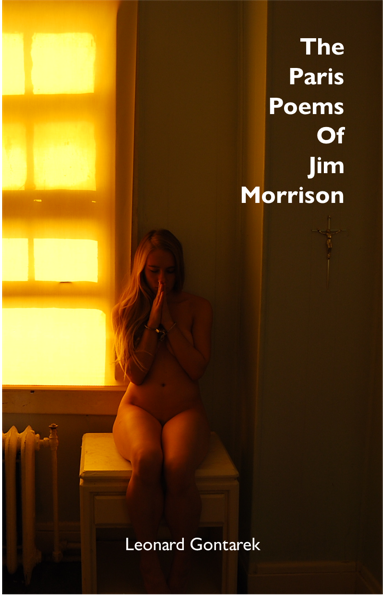
Noted Philadelphia poet Leonard Gontarek summons the spirit of the iconic front man of the 1960s rock band The Doors with his recently published book, The Paris Poems Of Jim Morrison. This collection—theoretically, the poems Morrison might have written if he hadn’t died in Paris in 1971—draws the reader into a fragmented dreamland in which the narrator struggles to know himself and his surroundings, in which there is “[m]ore there than it seems.”

The Doors began recording and performing in the mid-1960s. Jim Morrison, the band’s lead singer and songwriter, was heralded as both sex symbol and countercultural icon. But he was also something else: a poet. Morrison’s collection of poetry, An American Prayer, was published in 1970.

By 1971, Morrison was in a bad way. He’d been convicted of profanity and indecent exposure for his behavior during a concert and was facing jail time. And he’d developed a serious alcohol dependence. In March of that year, Morrison joined longtime girlfriend Pamela Courson in Paris, hoping to find an escape from his troubles and a chance to write. But several months later, on July 3, he died there at age 27 under dubious circumstances. Courson reportedly found him dead in their hotel room’s bathtub. The official cause of his death was listed as heart failure, but no autopsy was performed, and rumors surfaced of a possible heroin overdose. The cause of his demise remains a topic of speculation.

Morrison’s troubled nature is highlighted in Gontarek’s poems. In 43 pages of untitled free verse, in which it’s sometimes hard to tell where one poem ends and another begins, one perceives Gontarek’s Morrison to be lost in a landscape in which “[t]he signs are blank.” He seems to be at odds with his surroundings, as in the opening poem:

I never dress for the weather
I believe I am in hell
I am in Paris
I turn my collar up
I sip from my flask

The collection’s opening verses also give the impression of a narrator who is diminished: “I have failed, one wing hangs down.” And, as he muses later: “Could I ever see into things? There was a time I thought I could.”

The landscape here at times seem impenetrable. The narrator struggles to make sense of it—to find his way into it, or perhaps out. And words, instead of communicating, contribute to the fog: “The language here softens, everything, out of focus.” We glimpse an incoherent picture, much like the one the narrator describes as “[b]ad reception. Feeding back flickering images of a room.”

In some cases, Gontarek tosses disembodied words, images, and thoughts to the reader, giving the impression of poems that are perhaps incomplete, perhaps struggling to emerge: “Wouldn’t want. / Never. Knew. Want. The ship. Burning.”

This is a shifting, multilayered reality in which “what is behind things still waits behind things” and “[w]hat is revealed is revealed. What is hidden remains, small cold blue flames.” Gontarek’s narrator continues: “Everywhere I turn is something I don’t understand becoming a part of something else, combusting.”

The narrator seems to try to discern the truth in a world in which all is untrustworthy and appearances can be deceiving.

Passion and anger resemble each other…
Overcast days remind one of autumn
In reality, it is otherwise.

Within this unknowable landscape, the narrator is likewise unknowable and questions his own identity. He struggles to understand his own consciousness and asks, “What hand, opening and strange, comes out of these clothes.”

Seeking assurance of his own existence, Gontarek’s Morrison finds a welcome, orienting power even in his own name: “The scent is unmistakable. Jim.” And “Morrison. It holds me here holds me.”

Gontarek’s poems are rife with references to the natural world: flowers, birds, trees, grass, bodies of water. However, instead of being pure or trustworthy sources of salvation, Nature seems as suspect as everything else. Gontarek refers to an “old pond smell” … “The odor of river” … “The crow that scars the sky.”

The narrator is like an explorer who reports the rich findings of his senses, whether sight, scent or sensation.

Often, too, he refers to sadness. But running as a counterpoint to that sadness is his desire, which perhaps constitutes the heartbeat of the book—the desire to understand himself and his surroundings, to find his way. At times, the desire manifests as sexual.

Are you home now?
The earth is lonely.
Are you hungry for me?

Also hovering throughout the book is the topic of death, which emerges and re-emerges. Early on, the narrator reflects: “I don’t write too much about death. / I don’t write enough about it.” He suggests a positive view of death when he says, “All avenues lead to where pain ends.” 

Gontarek’s Morrison acknowledges himself as an imperfect narrator, and perhaps an imperfect poet, when he tells readers, 

I can only lead you to the cliff.
I’ll hobble behind swinging a lantern.
Pissing off a rock. Passing off shit as poetry
and god.

The Paris Poems Of Jim Morrison will be especially enjoyable to those familiar with Morrison and his story, as well as anyone interested in joining Gontarek’s Morrison in what could have—might have—been part of this legendary figure’s final journey.


abbey.jpg

Abbey J. Porter writes poetry and memoir about people, relationships, and life struggles. She holds an MFA in creative writing from Queens University of Charlotte, an MA in liberal studies from Villanova University, and a BA in English from Gettysburg College. Abbey works in communications and lives in Cheltenham, Pa., with her two dogs.

Source: http://madpoetssociety.com/blog

Profession: Poet

Profession: Poet

January 5, 2021

Profession: Poet is a new monthly blog feature exploring craft and identity in poetry by Hanoch Guy, who writes poems in both English and Hebrew.

Welcome to my first poetry blog entry. Thank you for reading. What I am going to share with you here is personal, and I hope what I write will evoke a lively back and forth between us.

When I am making small talk with somebody I have just met, and they ask what I do, I respond: “I am a poet.” Usually, people just say, “Oh,” or they laugh or shrug, waiting for me to say something else.

Why do I say I am a poet?

It is my need to be precise. As others do, I could say I am a writer or an author, but that does not satisfy my need for precision.

To answer that I am an author or writer may lead to more conversation-making questions or an interesting discussion. In stating that I am a poet, I affirm my being.

Sometimes, people ask what kind of poetry I write, and I doubt, though I am a professional poet and I devote most of my time to the different aspects of a poetic career, whether they are interested or if I can deliver the goods in one sentence.

What I have learned for myself, over a long interval of time, is that poetry is more like a high-risk investment rather than a steady money-making enterprise. I intend in the future to develop the monetary aspect of being a poet.

I realized that poetry, and being a poet, is much more than my profession. It is an integral and essential part of my whole being. It is my alter-ego.

It is my twin in the mirror who reflects at different times different aspects of myself.

Without poetry I am lacking something essential for my soul, its raison d'etre.

Let me tell you how poetry became integral and indispensable to my life. When I was twelve years old in Israel, our English teacher introduced us to a few poems. Listening to Shakespeare and Goethe, I felt something stir in me. I did not understand a word of German, but Goethe’s poem moved me.

Throughout my adolescence, its numbness and depression, I was disinterested and bored in school, but I made an effort to keep up with English and Hebrew literature. A vague feeling grew in me that I wanted to write. I was not sure of how to and of what to write about, but I filled notebooks with rambling writings.

I was lucky and grateful that a high school teacher met with me every weekend and, without judging what I wrote, encouraged me to continue writing. Throughout these high school years, I wrote poetry almost without any editing. A farmer across the road was an avid reader and bought stacks of books for me. Every book that he finished reading, he would give to me to read. We would discuss each book after I finished it. I was introduced to Tolstoy, Dostoevsky, Turgenev, Flaubert, Stendhal, and others in Hebrew translation. I started reading the romantic poets, Shelley, Byron, and Wordsworth, also in Hebrew translation.

By the time I came to Jerusalem to get my degree in literature, poetry had grown in me to become more and more demanding of my time and concentration. During this time, the work and challenges of a heavy course load, as well as a full-time job and my loneliness, the life of poetry and writing grew within my inner being; it comforted and affirmed me.

I tried to publish by first sending out a few poems that were rejected, and on two occasions my own person was rejected when I was thrown out of editors' offices. Once, I was upset because the literary magazine Akhshav (Now) rejected my submission, and I rushed to the editor’s office on Allenby Street in Jerusalem. It was raining hard. I opened the door and a short man with thick glasses barked, “What do you want?”. I explained. He screamed, “Get out! You’re dripping on the floor!”.

In January 1970, something changed in my poetry writing when I was at a friend’s home. I went to the bathroom, sat on the floor, and wrote a poem in English with a red crayon.

A decade followed of writing mainly in English, of submitting poems and, with a few exceptions, of having them rejected. But now I had within me a twin being of Hebrew and English poetry, each one independent, distinct, and demanding to be nurtured and cultivated. Then I experienced a long period of silence in which I was aware of my twins but was unable to take care of and respond to them because of my decision to try a new career, teaching full-time. I was so occupied and exhausted by my two parallel careers, poetry was repressed, and I felt I was unable to write or even read poetry.

I was not able to write at all.

It was fifteen years until I was able to return to my poetry-twins with more devotion, commitment, and concentration than ever. I had decided to end working as a wellness consultant, and I felt much lighter. My return to poetry was easy, joyful, and brought the warmth of coming home.

I’d like to end by offering a haiku from my book, A Hawk in Midflight, which can be purchased here.

Poetry is the
shortest distance
between tears


Hanoch+Guy.jpg

Hanoch Guy Ph.D, Ed.D spent his childhood and youth in Israel. He is a bilingual poet in Hebrew and English. Hanoch has taught Jewish Hebrew literature at Temple University and poetry and mentoring at the Muse House Center. He won awards in the Mad Poets Society, Phila Poets, Poetry Super Highway and first prize in the Better than Starbucks haiku contest. His book, Terra Treblinka, is a finalist in the North Book Contest. Hanoch published poems in England, Wales, Israel, the U.S., and Greece. He is the author of nine poetry collections in English and one Hebrew book.

POeT SHOTS - '"How to Stuff a Pepper" by Nancy Willard

POeT SHOTS is a monthly series published on the first Monday of the month. It features work by established writers followed by commentary and insight by The Mad Blogger, a mysterious figure who is in love with poetry and the power of the written word.

image.jpg

How to Stuff a Pepper

by Nancy Willard

Now, said the cook, I will teach you
how to stuff a pepper with rice.

Take your pepper green, and gently,
for peppers are shy.  No matter which side
you approach, it's always the backside.
Perched on green buttocks, the pepper sleeps.
In its silk tights, it dreams
of somersaults and parsley,
of the days when the sexes were one.

Slash open the sleeve
as if you were cutting a paper lantern,
and enter a moon, spilled like a melon,
a fever of pearls,
a conversation of glaciers.
It is a temple built to the worship
of morning light.

I have sat under the great globe
of seeds on the roof of that chamber,
too dazzled to gather the taste I came for.
I have taken the pepper in hand,
smooth and blind, a runt in the rich
evolution of roses and ferns.
You say I have not yet taught you
to stuff a pepper?
Cooking takes time.

Next time we'll consider the rice.


A pepper indeed!

Willard’s poem takes the simple act of preparing a pepper for cooking and turns it into something much more, something sensual, exotic, and full of wonder. There is such a celebration of the mundane in describing the act of opening the pepper as a “conversation of glaciers,” and referring to the innards of the pepper as a “great globe of seeds.” These lines are meant to force us to reconsider the everyday tasks we complete. When we cook, we often rush through, working toward making a complete meal but forgetting that the real joy of cooking (pun maybe intended) lies in the act of cooking itself and all its sundry parts.

In reading this poem, one cannot ignore the subtle sexual tension of the poem. The cook (who is speaking for most of the poem) often compares the pepper with femininity, imagining the pepper in “silk tights,” and using “the moon,” “pearls,” and “temple” to describe the pepper’s internal chamber. Since this is the cook talking, it makes us wonder about the relationship between the cook and the speaker of the poem, who we can assume is Willard. It adds a layer of texture and meaning to the poem, but does not fully resolve it. Like much good art, this poem raises more questions than answers, not relying on exposition but rather capturing a moment in time and forcing us to interpret what we see based on our own context.

The thing that really makes this poem work, though, is its treatment of the ineffable. Try describing the color green to me. Tell me what chocolate tastes like. And try to describe the act of cooking a pepper. The only way to capture these experiences is to compare them to similar things. This poem is a masterclass in that, gently linking the act to imagery and metaphors that helps us understand the experience in ways that direct description could not. Believe me when I say this Mad Blogger’s taking notes!

The Mad Blogger is dedicated to showing that poetry is not some mystery. There are no right or wrong ways to read poetry; it is for everyone to read, understand and enjoy. The Mad Blogger is all of us and none of us. As long as people still believe in the power of the written word, The Mad Blogger will be there, providing insight, perspective, and (hopefully) inspiration.

Source: POeT Shots: How to Stuff a Pepper by ...

Review of Rocky Wilson's Dance with Me

Review of Rocky WIlson’s Dance with Me

December 23, 2020

Capture 1.PNG

Dance with Me

Moonstone Press

$10.00

You can purchase a copy here.

Reviewed by Philip Dykhouse


The first time I saw Rocky Wilson perform, I was sitting at a table in the back of the upstairs bar at Fergie’s Pub in Philadelphia. I was quietly sipping on a beer and waiting for the Moonstone Poetry reading to start. The room was packed with a lot of unfamiliar faces and there was an electric energy in the air. I kind of felt like a stranger who had successfully integrated himself into a party he had not been invited to. Soon the host began his introduction, during which he referred to Rocky as “The Puppet Laureate of Camden.” I was a bit perplexed as I watched this eccentric, older gentleman take the stage and place a monkey puppet upon the podium, to great applause no less. With a smirk on my face, I thought to myself, “Who is this guy”?

After the fanfare quieted down, he cracked a few successful jokes and began to read to us. Well, it was not long into his set that I realized why this poet is so revered. Much like the man himself, Wilson’s poetry draws you in with touches of theatrics, humor, and an undeniable ability to connect with its audience. With a breezy wit and gift for creating genuine emotion, Wilson crafts poems that feel like stories you need to see to the end. Nowhere is this more apparent than his latest chapbook, Dance with Me.

In the book’s biography, Wilson states that his intent was to blend “his love of dance with his love of poetry,” and he succeeds because, like a great dance partner, Dance with Me takes you by the hand as it leads you through 17 poems exploring the many dynamics of human relationships. Every piece in this collection feels as though it is a personal conversation between the author and the reader. The poems are intimate and vulnerable yet offer a sense of optimism. They look into the past not with regret, but with astute reflection. Wilson wants to celebrate the lessons he has learned, and he wants the reader to be there with him as he does. Quite a few poems in Dance with Me focus on Wilson’s immediate family. The first poem “Starless Night” begins in a humorous tone as it describes how his family began, “Mom and dad getting hitched and me hiding way back in their thighs…” He talks about how his sister “…came out like Van Gogh with only one ear.” Yet, by the end of the piece we learn that Wilson’s younger brother did not survive his birth. Throughout other pieces in the book, we see that the loss of his brother has stayed with Wilson to this day. In “Namaste, Angels,” we find the poet musing about who his brother might have been: “Was my little brother ever happy? Well, he never had to wear hand-me-downs or eat Brussel sprouts.” Although it may seem melancholy at first, there is a sweetness to how he writes about his brother. It’s as if he is trying to instill a life in his brother that he was never given a chance to make on his own.

 This honest way of honoring the people Wilson loves, living or dead, extends to many other pieces in Dance with Me. In “Blackberries,” we find the author reflecting on how he now takes care of his father after so many years of the opposite: “Feeding him now, he who fed us or at least paid for so many meals.” The next two poems offer a perfect segue into each other and the prior. In “Bloodlines,” you learn that Wilson’s father was drafted into Vietnam and how it affected his grandmother. Wilson writes,  “Gram prayed that if it came down to it, his life be taken first. She didn’t want him to live with another man’s life on his conscience.” With the following poem “What Do You Want?,” Wilson describes how when his grandmother died, the only belonging of hers that he wanted were locks of her own hair that she had saved: “I want to look at it again and feel it and smell it and remember Grace.” These poems feel as interconnected to each other as the poet is with his own family’s past, present, and future. They truly are a highlight of Dance with Me.

One of my favorite moments in the book comes with “Dear Mr. Cohen.” Here we find Wilson crafting the poem as if it were a letter to his late idol, Leonard Cohen. In the poem, he asks Cohen to sing his famous song “So long, Marianne…” to his recently deceased friend Marianne: “You can sing that song to her yourself now, Leonard, or better yet, “Hello Marianne…”. Dance with Me is filled with so many beautiful and unique odes like this. It is quite obvious that Wilson’s words show a true appreciation for life, even in death.

Throughout Dance with Me, Wilson’s love for dance and performance are highlighted perfectly in some of the book’s more playful pieces. In “Sunday Matinee,” we find the poet at a performance of Romeo and Juliet where his own thoughts on the play- “Don’t drink it, I want to scream, she’s not really dead!”- contend with those of a snotty audience member: “Juliet is too small, she says frowning, and Romeo’s too thin”. From here he wonders if watching an Eagles game would be more satisfying. However, he eventually finds himself back in his seat and crying by the end of the third act. In “Twist Again,” Wilson recalls a romantic relationship from his teens in which a girl taught him how to properly perform both The Twist and a French kiss. With “After Seeing David Parson’s ‘Mood Swing,’” Wilson explains to the reader how this particular movie changed him: “At some point in the movie a little dam broke inside me…”. These poems as well as the others I have not mentioned excel in showing the reader how these moments have a positive effect on Wilson’s outlook.

The book ends with the poem “Pas De Deux,” which imagines the poets Walt Whitman and Robert Frost becoming close friends as they climb a tree, ride the ferry, attend a baseball game, and “…sing the songs of the open roads not taken”. It’s moments like this and so many others that add up to make Dance with Me such a joy to read. It’s heartfelt and funny. I know its probably a rare thing to describe a book of poetry, but I found that reading this book was fun. It brings me back to that night in Fergie’s and makes me appreciate the art of performance and the camaraderie of people. I began that night hiding on the side of the dance floor, but when Rocky Wilson used his beautiful poetry to hold out his hand and ask me to dance, I took it. I am so glad I did. However, if you ever get a chance to cut in, please take it. I promise I will not be offended.


Phil+-+headshot.jpg

Philip Dykhouse lives in Philadelphia. His chapbook, Bury Me Here, was published and released by Toho Publishing in early 2020. His work has appeared in Toho Journal, Moonstone Press, everseradio.com, and Spiral Poetry. He was the featured reader for the Dead Bards of Philadelphia at the 2018 Philadelphia Poetry Festival. 

Source: Review of Rocky Wilson's Dance with Me

Local Lyrics - Featuring James Feichthaler

yeahsonwhatt.jpg

Excerpt from The Rise of the COVFEFE
By James Feichthaler

Our wrath is felt all over this damned globe, 
From Wuhan to New York to Southern Cali!
From Rome to Egypt, like the trials of Job, 
At every Black Lives protest, march, and rally!
Felt like a hernia or a ratings-tally 
That Emperor Biff Tweets out (on rare occasions)
To get more likes, more looks from neighboring nations.

Felt like a gut-punch, with each dashcam blunder
That shows another thug shot from behind!
Or with his hands up, screaming out in terror!
Or tear-gassed, tased, kicked, bludgeoned, going blind!
Or sprinting down the avenue (like the wind)
To avoid our SWAT of shotgun-carrying ghouls, 
Like Usain Bolt dashed when he ran the jewels.

 All in your feels, your rawest of emotions, 
Your thoughts, your prayers, your teary-eyed emojis!
Your pleas for peace, your wild ‘defund them’ notions, 
Which make us laugh so hard we have to cheek-squeeze
To hold shit in! You libtard fucking hippies 
Wouldn’t last two minutes without laws or coppers!
Soft as the sturgeon eggs we spread on crackers,

As a baby’s bottom, velvet, silk pajamas, 
A supermodel’s perm, some melting Gouda, 
A bed of feathers, dog shit, shampooed llamas,
The felt-smooth petals of a spring Begonia!
Like a mako circling an injured tuna,
The wolves would sniff you out (in these cold waters)
So fast you'd wish your bitch-ass took our orders.


What got you into poetry? And why do you continue to write it?
My earliest memory of poetry affecting me in a major way is when I first read William Blake’s ‘The Tyger’. The gorgeous phrasing of the first stanza in the poem sucked me in, and the fearful symmetry of Blake’s words have stayed with me since. I’d say it was about a year or so later, when hip-hop music and Shakespeare strutted their way into my life around the same time, during my sophomore year in college, that I really became intrigued with poetry and started paying close attention to the craft -- how certain poets/MCs put words together, and how creatively and powerfully they used their words to express what they were feeling at a particular moment in time.

I wrote poetry, and continue to write it, because it’s in me I suppose -- it calls to me, night, day, 4 a.m., 6 a.m., midday, at sunset, when I’m on the crapper, in the shower, standing in line at the grocery store. At times, it’s therapeutic; at other times, it’s a way of staving off the madness of everyday life. I also think that the creativity aspect of poetry, the natural high of writing that lends itself to the unexpected, makes it something very alive for me and new and beautiful at the start or finish of every poem; even in the creation of certain phrases, lines, words, etc. It’s all gravy and thrilling, and maddeningly, joyously, deliciously challenging, and gratifying when it comes.

How do you start a poem? What does your process look like when that all-possible-blank-page is in front of you?
For me, the poem usually begins with hearing the music of the first line or two in my head, then going for it. If I think too long or hard on a subject and sit down to write ‘the poem’, it never arrives. I might be looking out my window at some squirrels chasing each other around the yard, or staring up into the sky, or sitting at the bar when the inspiration comes; any place really, when a new idea or line for a poem will reveal itself to me. I have half-jokingly called the poet ‘The Great Regurgitator,’ in that the juiciest bits of writing that find their way into a poet’s work are usually the bits and pieces of his or her life that have been brewing in the bowels of memory and subconscious for quite some time. The act of writing is a revisiting of thousands of conversations, thoughts, emotions, words never spoken, feelings never expressed; a very primal and sudden reflex to all these swirling together in some forgotten dungeon of the soul that causes poetry to spill out gloriously at the moment of composition -- sometimes a bit messy in expression, but always on point and real if the poet is being honest about life experience.

You are a musician as well as a poet. How does music inform your poetic voice?
As far as the written word goes, each poet has a natural music or rhythm within that is unique to him/her alone, and that natural rhythm in me is what I roll with in everything I write. Where rap poetry is concerned, when I hear a beat for the first time, the vibe of the music can often determine what type of song I’m going to write. For instance, if the beat is dark and gloomy, with a heavy bassline and a chillingly-haunting piano dancing through it, it would most likely inspire me to write something serious and introspective. If the beat runs at a faster clip and has a high-pitched horn in it or a triumphant string sample carrying the music along, it might stir some inspirational verses in me, or cause me to get super creative with the wordplay. 

I like to write most of my rap verses when I’m in the studio, especially when creating a song from scratch, which is how Sean Bombz (who produces all my music these days) and I like to work. When Sean plays me something back through the speakers that strikes a nerve, no matter where we’re at in the process of creating a song, I’ll ask him to put the music on a continual loop and begin writing to it. When the initial jolt of inspiration that the music sparked in me is gone, it’s tough to get it back and write to the same song again at a later date, even if it’s just a day or two down the line when I return to the studio. This is why I try to bang all my verses out in the same session, and record them all too if I can.

In your new book, The Rise of the Covfefe, you wrote the entire epic poem in iambic pentameter. How did you decide on this meter? Was there ever a point when you thought of straying from it? How did you keep it going?
In getting my poetic chops ready to step into the ring with the COVFEFE, I went back to the classics: Byron’s Don Juan, Shakespeare’s The Rape of Lucrece, and Keats’ longer poems were always close by. I feel like it was almost a subconscious choice choosing Shakespeare’s stanza form in Lucrece that started the poem off, and I just ran with it. Never thought of straying from the stanza form or its meter, as the COVFEFE warned me ‘not to’ under penalty of death. They threatened to tase me in Times Square with a wire that stretched down from one of their corporate suites, and to broadcast this barbarianism internationally.

How did I keep the poem/meter going?

Insomnia and beer...and a true fear of never finishing the damned thing before the election.

You host the Dead Bards of Philadelphia readings and open mics? What are your favorite things about live poetry performances? What advice would you give to first-timers?
My favorite things about hosting Dead Bards readings and attending live performances, in general, is that I get to meet a lot of fine people who are genuinely serious about their craft, and sometimes there’s even food and wine at these events. I also like it when it’s my turn to read and four or five people in the audience have already left because who they came to hear is done reading and they have to rush home to watch The Masked Singer

My advice to first-timers sharing their work is this: watch, study, listen, learn, and work hard at your craft. Pay attention to the audience’s reaction to your work. Is it a real response you’re getting when you read, or a contrived one? Read confidently, and know that everyone else who read their poetry before you that evening, at whatever event you’re at, was also pissing their pants to some degree before they read but very good at not showing it. Don’t expect anything from anyone in the poetry biz, but when someone offers help, take it. When someone tells you they don’t like your poem, take it. When someone gives you advice, take it…with discretion. When someone tells you they love your poem, take it…with discretion. Rejection upon rejection will come, with some takers, so always believe in yourself. Speak loudly and proudly, and carry a big Bic

Where can readers find more of your work? Buy your book?
I have a few poems up on the Web, with a poem most recently published in ONE ART. At this moment in time, however, I would recommend people purchase my book The Rise of the COVFEFE if they would like to discover more of my work; there’s 47 pages of it right there. If you don’t like the first page, burn it. If you don’t like the second page, burn it. If you don’t like the book, after 20 reads, burn it. If you do happen to like my book, share the link with your friends online somewhere or via text, or buy a copy for them. I don’t think people realize how crucial social media word-of-mouth is to a writer’s survival these days, and how essential one good word or two can be for one’s reputation as an artist. One share of a link can lead to two or three book sales; it’s that simple.

My book is available for purchase at Amazon, where paperback and Kindle versions abound.

You can also you can shop Philly-local and purchase it from The Spiral Bookcase, who is carrying my book on their website.


meyo.jpg

James Feichthaler is the author of The Rise of the COVFEFE (recently published by Parnilis Media) and hosts The Dead Bards of Philadelphia, an open mic poetry reading series that takes place once a month at The Venice Island Performing Arts Center in Manayunk, PA. With a sharp focus on politics, humanity, and the chaos of the world we live in, Feichthaler's epic poem The Rise of the COVFEFE addresses the seriousness of these divided times with a brutal honesty and sharp humor, and the dark undertones that haunt its stanzas speak to the frail uncertainty of a society unhinged.


wojto.jpg

Catfish” John Wojtowicz grew up working on his family’s azalea and rhododendron nursery in the backwoods of what Ginsberg dubbed “nowhere Zen New Jersey.” Currently, he works as a licensed social worker and adjunct professor. He has been featured in the Philadelphia based Moonstone Poetry series, West-Chester based Livin’ on Luck, Mad Poets Society, and Rowan University’s Writer’s Roundtable on 89.7 WGLS-FM. Find out more at: www.catfishjohnpoetry.com.


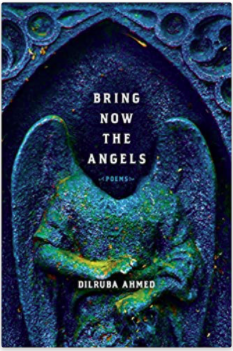
Review of Dilruba Ahmed's Bring Now the Angels

Review of Dilruba Ahmed's Bring Now the Angels

December 16, 2020

Capture.PNG

Bring Now the Angels

University of Pittsburgh Press

$17.00

You can purchase a copy here or at Amazon.

Reviewed by Brooke Palma


Dilruba Ahmed’s Bring Now the Angels is a collection of poems that bravely documents the simultaneously difficult and joyful moment of its creation. The poems explore Ahmed’s father’s illness and subsequent death, her relationship to her young sons, and the challenging circumstances of modern life in America. These three topics are equally present and provide witness to their personal and historical moment.

The poems that describe the poet’s father’s illness are remarkable for their visceral images. Ahmed’s use of images centering on the body is particularly effective. In the first section’s opening poem, “The Feast,” Ahmed describes a final family picnic where her father slices a melon with “each piece bleeding onto a white plate” and grills meat from “blood red to clear.” In describing one of the last happy family gatherings before her father’s illness, Ahmed foreshadows the disturbing nature of what is to come.

As the first section progresses, we witness the indignities of Ahmed’s father’s illness. “The Longest Hour” shows us the ways the body fails us and the ways illness becomes a humiliating experience: “[t]he too short gown. The catheter.” As the poem continues, Ahmed asks,

Will nothing
be spared; will nothing remain unseen?

When the body undoes

its beauty, will you see how shroud-like
the bed sheets, how small the bones
against them?

After her father’s eventual death, in “Extending the Invitation,” Ahmed comes to the conclusion that there is “[n]othing to do now but grieve.” While describing the sound of the “endless grating” of the casket being lowered into the open grave at his funeral, she reminds us of the essential paradox that death presents:

…the living know
nothing, and can speak —while the dead
know everything, but are mute.

Section II finds Ahmed returning to a life without her father. In “Drift,” she finds that there “is still, somehow, laughter in the fields. Poppies making the grass a slow wildfire…” in the woods where she plays with her sons. This moment of connection with her sons among the beauty of nature stands in stark context to the disturbing images of the prior section. In this poem, we see how Ahmed’s relationship to her children is changed after her father’s death, deepened with a new appreciation of time’s “darker and darker shades of gold.” By focusing on the fleeting nature of time, Ahmed calls us to both appreciate the passage of time and the ephemeral nature of our own lives.

The end of the collection finds Ahmed discussing the greater world at large. These poems focus on global issues: the water crisis in Flint, Michigan; underground education for girls in countries where the Taliban is in control; and climate change, among others. As readers, we see a shift in the collection at this point from the personal to the political. Although, due to Ahmed’s skilled writing, it becomes clear that the personal and the political are inextricably linked.

 Dilruba Ahmed’s Bring Now the Angels bravely confronts a difficult time in the poet’s life. These poems are both the wound and the balm. They provide the reader with a visceral retelling of her experience while also having the courage to ask difficult questions about the role of suffering in our modern world.  


Brooke+Palma+headshot.jpg

Brooke Palma grew up in Philadelphia and currently lives in West Chester, Pennsylvania. Many of her poems focus on the connections between culture and identity and finding beauty in the everyday. Her work has been published in The Mad Poets’ Review, Moonstone Arts, Toho Journal, and E-Verse Radio (online), and work is forthcoming in Unbearables: A Global Anthology (spring 2021).  Her chapbook, Conversations Unfinished, was published by Moonstone Press in August 2019. She hosts the Livin’ on Luck Poetry Series at Barnaby’s West Chester. 

Review of James Feichthaler’s The Rise of the COVFEFE

Review of James Feichthaler’s The Rise of the COVFEFE

November 24, 2020

thumbnail_Covfefe.jpg

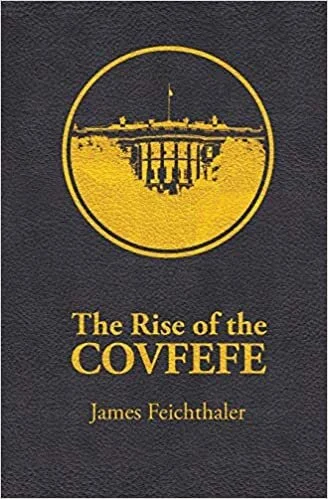
The Rise of the COVFEFE

Parnilis Media

$17.50

You can purchase a copy at the Spiral Bookcase in Manayunk or at Amazon.

Reviewed by Chris Kaiser


No one can say the past four years haven’t produced tension and drama, given the political ploys of President Donald J. Trump. Those opposed to Trump and his antics breathed a sigh of relief after the election. Those who support the president are still holding their breath, hoping that the election was somehow tainted and the result potentially disputed.

One thing not in dispute is the president’s penchant for Twitter.

One of the more puzzling and memorable moments of the presidency was an enigmatic tweet on May 31, 2017: “Despite the constant negative press covfefe”. The tweet remained on Twitter for several hours, prompting scores of curious Americans (and foreigners too, I presume) to wonder what in the hell was “covfefe”.

The president eventually deleted the tweet, but taunted his millions of followers six hours later with this tweet: “Who can figure out the true meaning of ‘covfefe’ ??? Enjoy!”

Who indeed? I’ll tell you who: James Feichthaler. In his new chapbook, The Rise of the COVFEFE, poet, rapper, and wordsmith Feichthaler lays out who the COVFEFE are and what they want. As he writes, “It’s good to be the king! In our case ‘kings’, / Conquistadors of cash, monarchs of mayhem!”

This epic, 47-page poem takes readers on a satirical journey through popular and political culture unlike any I’ve ever been on. The number of references to movies, songs, sports stars, conspiracy theories, historical events, and notable politicians and leaders is astounding.

Feichthaler takes the pulse of Americana and delivers his assessment: The COVFEFE is the beating heart of America, the secretive group behind anything and everything that happens. Feichthaler explains:

Which begs the question: what do we all do
With so much time on our elitist hands?
Well, when COVFEFE isn’t watching you
Or dropping Mother Bombs in peace-starved lands,
We’re breaking bread with some of our best friends.
Last week, we had a night out with The Russians;
Great cover band! Kim Jong was on percussions.

What’s amazing with the poem is that Feichthaler delivers this send-up in iambic pentameter, with the same rhyme scheme as Shakespeare’s “The Rape of Lucrece”: ABABBCC.

Feichthaler’s iambic rant satirizes many presidential flubs, such as when Trump said during a July Fourth speech that George Washington’s army took over the airports to hinder the British advance:

Back then, there was no place for him to land
His fleet of jets; so, when he saw the British,
He rammed their ramparts like a whore that’s Finnish.

Feichthaler’s sense of humor is sometimes subtle, sometimes outlandish, but always on target. The book opens with a Swiftian-like preface claiming the manuscript was found in Area 51 “between the skull of Elvis and a stack of Megalodon teeth.” The author of the preface, a Gladlok P. Anderson (wink wink), attests to the veracity of The Rise of the COVFEFE and introduces us to the concept of the COVFEFE being a covert group of elite movers and shakers

The poet covers a lot of ground in his epic poem. Some of the people and topics mentioned include: Brian Williams, Jeffrey Epstein, Kid Rock, Shaquille O’Neal, Genghis Kahn, Napoleon, Van Gogh’s ear, Osama Bin Laden, Vlad the Impaler, Stormy Daniels, Charlottesville, Big Pharma, iPhones, opioids, The Rhodes Colossus, St. Patrick’s Day, Wiki leaks, millennials, Bud Light, Pornhub, and STDs.

Many parts of the poem are like entries straight out of America’s journal, recounting some of the conflagrations that have taken place not only in the last four years, but also stretching back to Columbus, who discovered the “Land where the pilgrim spread hysteria / And smallpox….”

 One modern-day focus that the poet takes aim at is defunding the police. The puppet masters don’t like this. The narrator questions:

Defund the Po-Po? The fuck is you, insane?
Those keeper of the peace? Defenders of it?
If any of you scarecrows had a brain
And used the good sense (God gave you) within it,
You’d know COVFEFE even has a limit
To what we’ll do to keep the fairytale rolling,
And asking us to ‘defund’ is just trolling.

Feichthaler humorously adds: “That shit’s like asking Biff to back Obama, / Obamacare, Obama steaks, Obama coffee! / Obama waffles, B’rack Americana!”

 The COVFEFE refer to Trump as Biff, a reference to Biff Tannen in the Back to the Future movie franchise. If you recall, Biff operated out of a casino in the second movie installment, echoing Trump and his Atlantic City casinos.

 It’s obvious that Feichthaler has fun with words. The sheer scope of the work attests to that: 187 stanzas, each with four rhyming mandates, and each line containing roughly 10 syllables.

 “I’m used to working in rhyme and meter,” Feichthaler said recently at a Zoom reading of his work. The poet also performs original work as a rap artist under the name Taliesin (aka Big Tal). You can check out his music here.

One of the verbal devices Feichthaler employs in The Rise of the COVFEFE that I enjoyed is the repetition of words or forms of words within a sentence. Here are a few examples:

“The left’s alright, but still they right no wrongs”
“More prompters prompting Merica’s malfunction”
“More death-clout chasers, dead men chasing clout.”
“For you to win, at losing, losing nothing”
“Keep making pointless point”
“The best excuser for our worst excuses,”

Feichthaler lives in the Philadelphia area and works as a proofreader. He has hosted the Dead Bards of Philadelphia poetry reading series for 9 years. His poetry has appeared in Sortes, Schuylkill Valley Journal, Martin Lake Journal, Toho Journal, and the Local Lyrics interview section of the Mad Poets website. Poets that have influenced him include: Shakespeare, Charles Bukowski, William Butler Yeats, Langston Hughes, John Keats, Lord Byron, and Robert Frost. Hip-hop and rap artists that remain influential to him include Nas, Tupac, Wu Tang Clan, Guru, and Everlast. The Rise of the COVFEFE is Feichthaler’s first published poetry book.

When Trump introduced “covfefe” in 2017, Feichthaler started writing poetic vignettes inspired by the word, and reading them at poetry venues. It wasn’t long before he realized that the word was bigger than even he thought and the idea took on a life of its own. That’s when The Rise of the COVFEFE was born. 

“I wanted the book to be entertaining, but it’s a serious work,” Feichthaler said at his Zoom reading.

 I’d say mission accomplished. At times the cultural references can seem daunting; there’s just so many of them. But when you get into a rhythm with the work, the laughs flow and the brain stretches to capture all the input.   

One last note. I recommend keeping track of how many times you read the book, because one of the COVFEFE commandments is:

Thou shalt abandon reason, truth, and read
The Rise of the COVFEFE twenty times,
Then burn the damned thing, just because it rhymes.


Chris Kaiser.jpg

Chris Kaiser’s poetry has been published in Eastern Iowa Review, Better Than Starbucks, and The Scriblerus. It appeared in Action Moves People United, a music and spoken word project partnered with the United Nations, as well as in the DaVinci Art Alliance’s Artist, Reader, Writer exhibit, which pairs visual art with the written word. He’s won awards for journalism and erotic writing, holds an MA in theatre, and lives in suburban Philadelphia.

Local Lyrics - Featuring Neti Neti

Absolutions from Shark Fin Cove
By Neti Neti

Crashing —
awash with purple passion
first flow then howling
scowling at the blissful sun

IMG_1460.jpg

Blazing —
dried up with your eyes cupped
I'm spilling and I'm sorry
enough of you evaporates

Laughing —
and I'm supposed to enjoy this?
When the foam felt like home
and your body was a mountain?

Shadows —
cascading on the gallows
I'm as salty as a seaman
I'm as holy as a harlot

Sweet siren
I don't have much time left
please whisper how I ought to try
pranayama in the ocean 

It's deeper and
I get it now
It's               and
      deeper
I get it now
Blue bubbles 
rise up
sanctity anoints my house
eyes up

I open my mouth
This is helping
This is healing


How would you describe your poetic aesthetic? What draws you to poetry?
My aesthetic is one of authenticity, sincere reflection, and manifestation brought forth. It pays homage to my identity as a raw artist not afraid to be vulnerable, be a risk-taker, or make mistakes. I strive to bring mental health into the fold through my writing style itself, which incorporates elements of my anxiety and dissociation into every aspect of my writing, from content to form. My hope is to normalize the conversations we have around mental health and around each other. I guess that’s what makes poetry so appealing; it is an apparatus through which we generate sparks of dialogue and change. It is an opportunity to alchemize my consciousness into a form that I can weave and have total autonomy over. That may be the other draw to poetry for myself—it is also a potent medicine. Having a feeling or sense of control over your surroundings and circumstances is something sparsely felt by those who cope with depression, anxiety, dissociation, or PTSD, so to put myself in a situation where I can feel my own vibrations and, in effect, make others resonate with them is art and community in its purest form.

What’s is it like being a poet in Philadelphia during this tumultuous time?
I wish not to be overly simplistic or dismissive here, but I do feel a strong need to attune myself to the world’s call of change in this age of transition, and that can look different for many people. The truth lies somewhere deeper in a series of oppressive systems that have long been felt more harshly by many communities, from black and latinx to womxn and LGBTQIA+. Coronavirus became politically weaponized which only brought the crimes of racist, patriarchal, capitalist systems further into the light, and what should have never been a political endeavor had the average American choose between science/health and bills/economics. As the virus now surges beyond a point of control, there are days where I weep, and it is important that we experience these feelings fully. After all, we are going through a time of shared trauma. But it is also a time to stand up arm and arm and fight for justice and change for people like Walter Wallace Jr.; being an artist allows a certain type of strategy to share and heal and fight as one, and we should use that strategy politically, socially, and economically anywhere we can until all people recognize healthcare (and mental healthcare) as a universal right (for starters). We have a unique opportunity to engage in a renaissance of the soul and leave this Earth in a better state than our ancestors and it will require a conscious reflection of self and intersectional engagement in our communities.

You have a chapbook coming out. Tell us about it.
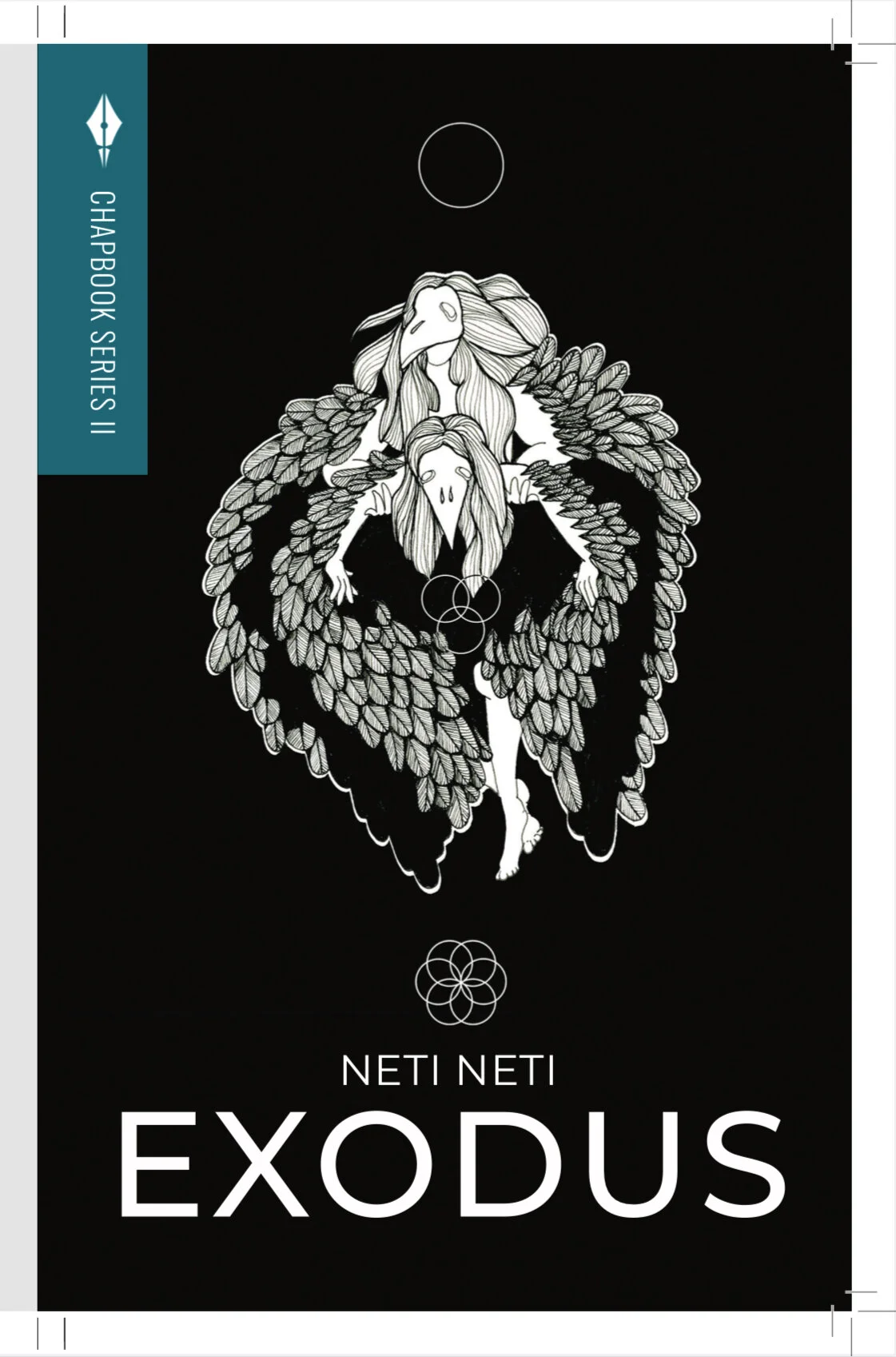
Exodus is, in many ways, a love letter. It serves to navigate the stages of grief over the loss of a child, the destruction of a relationship, the dismantling of self. It asks the fervent question, ‘Where do I go from here?’ when the call of l’appel du vide brings us to the precipice. It is, of course, a commentary on mental health and of spiritual identity, exploring what is truth and what is fallacy, or relative truths that we cling to in comfort to distract or hide us from the shadows of our own ego. In many ways, Exodus is seeing my true self for the first time in a raw and vulnerable form, and I want nothing more than for people to realize that there is true freedom and comfort in that. We can dismantle our egos, we can overcome generational trauma, we are not defined by our mistakes, and every day we are discovering ourselves further and we have the opportunity to show up for ourselves deeper. What we decide to call our attention and breathe our intention into will ultimately release us, and I hope there is a soul out there who may experience my book and find comfort and community in that isolation and in that healing. For a first edition creator copy (comes with goodies!) Please feel free to DM me on Instagram (@_neti.neti_) to reserve yours. You can also pre-order a copy direct from Toho Publishing at https://www.tohopub.com/product-page/exodus-neti-neti

How do you start writing? What does your process look like when that all-possible-blank-page is in front of you?
I need my words to bleed. It needs to be an organic and fluid process, and this is not always an easy endeavor when dealing with a constant state of dissociation. I find that what works best for me is finding a way to stimulate my senses and emotions, either through an immersive experience through sound or smell. Sometimes, I am captured by small phrases or soundbites while walking in the wilderness that I’ll compile into my notes, and other times I can regurgitate an entire limerick in a state of lyrical flow. I also tend to use that anxiety and dissociation in my writing process to reclaim that power and identity for myself, and the silver lining can oftentimes yield a very nuanced yet unique voice to my writing. There are days when I feel empty, and it is important to extend yourself grace in these moments so you can return, ready to write, with a fuller cup. There is beauty and joy in rest, but engaging your mind with writing prompts can also help.

As a writer, what would you choose as your mascot/avatar/spirit animal. Why?
What a fun question! Of course, I have interpretations as to what my spirit animal is as a person, but as a writer I would have to say a corvid (Crow, Raven family) but not for the reasons you may think! Of course, I’m an Edgar Allan Poe fan, but the spiritual connection may lie somewhere closer to the crow’s ‘trolling’ behavior! These birds tend to stalk and hop behind larger predators and peck at their backsides! The thought process here is an evaluation of larger predators or a means to steal food, but oftentimes they do this with no gain other than a social curiosity or commentary. For me, I’m able to view this behavior from a more light-hearted capacity to suggest that we can take on our own ‘predators’, namely the overarching thought processes and negative coping mechanisms that inhibit our ability to flourish. Not only can we peck away at these creatures to show that they hold no true power over our minds and bodies, but we can do so confidently, and God forbid, maybe with a little humor.

Where can readers find more of your work? 
For now, I encourage others to share space with me through my instagram, @_neti.neti_ . I do encourage everyone to stay tuned as I produce more published content, I should have a website of my own up and running shortly I am also working on relaunching my Creator Series, which seeks to highlight and promote artists of all kinds in the local area while supporting Philly nonprofits. I am reevaluating the impact and efficacy of this program and would like to bring it back as a more powerful space than it was before! As this is the last question of the interview I would like to thank you again, John, for honoring me with this opportunity to interview in a space like Mad Poets that houses and highlights some truly talented and inspirational voices; it was an absolute pleasure!


C672BE0C-06DE-4671-87FF-3B028681CDFC.JPG

Neti Neti is a Philadelphia-based poet focused on processing trauma and communal healing through allegory, symbolism, and imagery. He uses his dissociation and anxiety as a writing technique—evident in his sudden shifts in meter and airy subject matter—to empower identity rather than suppress it. He has a debut chapbook, Exodus, and has been featured in Toho Publishing as well as Yes Poetry. He is a spiritual pilgrim and a harbinger of endtimes.


wojto.jpg

Catfish” John Wojtowicz grew up working on his family’s azalea and rhododendron nursery in the backwoods of what Ginsberg dubbed “nowhere Zen New Jersey.” Currently, he works as a licensed social worker and adjunct professor. He has been featured in the Philadelphia based Moonstone Poetry series, West-Chester based Livin’ on Luck, Mad Poets Society, and Rowan University’s Writer’s Roundtable on 89.7 WGLS-FM. Find out more at: www.catfishjohnpoetry.com


Review of Deborah Turners' Sweating It Out

Review of Deborah Turner’s Sweating It Out

November 18, 2020

Capture.PNG

Sweating It Out

Finishing Line Press

$14.99

You can purchase a copy here.

Reviewed by Sean Hanrahan


In her debut chapbook collection, Sweating It Out, Deborah Turner breaks out from the pack. This metaphor is entirely appropriate since Turner refers to this collection as her “jock poetry.” As a reader may expect, she explores the connection between sports and self-discovery, but she also carves out poetic space to investigate income inequality, remember 9/11, and celebrate gospel music.

One of the strengths of this collection is Turner’s use of rhythm. In “Double Dutch,” she writes

Got two girlfriends
turning rope
as she hops nimble…
not letting twirling twine
come between
her pulsing connection
with the earth.

With her word choice and short lines, Turner invites the reader to join the poem’s main character, LaTasha, in double dutch. Turner proceeds with rich visual, aural, and kinesthetic imagery. LaTasha is precocious, watchful, and a fully realized poetic subject who realizes the “world outside them ropes/ain’t even here” and emerges out of playground jump rope chants that evocatively weave their way into the poem like “Go girl./You, go girl.”

In “Consumption,” the most overtly political poem in the collection, Turner tackles the media’s simplified infographic approach to showing income inequality. Echoing Langston Hughes’ “Harlem,” she writes

Show me
a blotted bar graph
boxing scenes
in a dream deferred

She mocks “cute little/USA Today diagrams” that reduce a serious issue into an inappropriately anodyne depiction of those struggling to make it in an aggressively consumerist society. Pulling no punches, Turner wants these news outlets to

Print me some proof
that purchasing power
means more than
a wish, a prayer
and a lottery ticket.

This powerful poem really hammers home the facile depiction of serious issues in our media, and it is my favorite poem in this collection.

Later in this collection, Turner turns her considerable poetic gifts to love. All poets have their love poems, but few display such tenderness as “Coming Down”, all while using 9/11 as a backdrop: “It was the year they toppled/the twin towers.” During this unprecedented and trying time in America, the narrator finds love that “came to [her] like a rain cloud/building over parched earth.” She continues with sensuous and expertly employed natural imagery:

your belly’s moist touch reaching
for my packed soil yielding
to your slow grove dripping
into my wanton crevice aching.

The shimmering beauty of this poem is captured in the final few lines that harken to and then move beyond the despair and destruction of 9/11: “And somehow, I was uplifted/by your full weight/coming down on me.”

In the final poem of this rich and layered collection, “When I Arise,” Turner, a fine singer herself, pens an ode to singing in the shower, that peaceful place where I am sure many poems and musical compositions are formed.

In the shower
my song can burst forth
for I feel safe
when groomed by liquid phalanges.

With tinglingly precise language, she describes the ablutions of the narrator’s showering routine. While performing these rote actions, she realizes “I have forgotten/the world outside my curtain.” She is lost in her own voice, singing the words from a gospel song:

I can feel it
moving,
moving on the altar
of my heart
every now and then.

The lyrics of the song cause her to “stand proud and naked” in front of her mirror: “Only she expected—demanded even/the peace-filled eyes/that return her bold gaze.” With these lines, this uplifting and gorgeous chapbook comes to an end. And for all you sports fans out there, Turner writes exuberant poems about baseball, basketball, and tennis. This chapbook has the power to enclose you in its pages and allows you, like LaTasha and the narrator of “When I Arise,” to leave the world behind. Seldom have I read such a rich and warm chapbook. Sweating It Out will be a volume poetry lovers can return to time and time again for sustenance, joyousness, and grace.
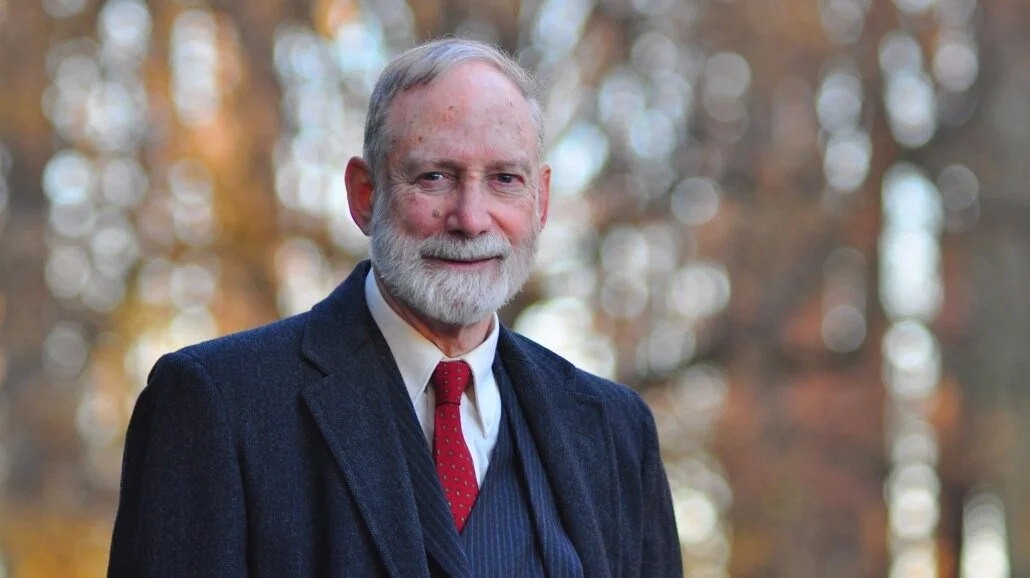

Hanrahan+headshot.jpg

Sean Hanrahan is a Philadelphian poet originally hailing from Dale City, Virginia. He is the author of the full-length collection Safer Behind Popcorn (read review here) (2019 Cajun Mutt Press) and the chapbooks Hardened Eyes on the Scan (2018 Moonstone Press) and Gay Cake (2020 Toho). He is currently at work on several literary projects as well as teaching a chapbook class. He currently serves on the Moonstone Press Editorial Board, is head poetry editor for Toho, and is workshop instructor for Green Street Poetry.

Review of Mike Cohen’s Between the Shadow and the Wall

Review of Mike Cohen’s Between the Shadow and the Wall

November 10, 2020

51itR1WRYXL._SX331_BO1,204,203,200_.jpg

Between the Shadow and the Wall

 Parnilis Media

$10.00

You can purchase a copy here.

Reviewed by Abbey J. Porter


“When in doubt, question all terms and definitions.”

I read this advice years ago, in a Calvin and Hobbes cartoon. Perhaps Mike Cohen saw the same cartoon. In his recent book, Between the Shadow and the Wall, the longtime Philadelphia writer challenges not only conventional language, but also conventional thinking. In this collection of poems and short tales, Cohen brings a fresh perspective and ironic humor to topics including time, aging, and religion.

The book’s title suggests an unnamed, unknown space—one we don’t readily see or think about—and it’s into this unfamiliar territory that Cohen leads us. His intent seems partly to disabuse us of our usual way of seeing things. As he points out in “When the Birds Say So,” the sun “doesn’t really rise, you know…never has.”

Cohen plays with language in a way that challenges the expected and familiar—as in “The Path of No Resistance,” in which,

Tired of taking the path of least resistance,
I have decided today to take
The path of no resistance at all.

Most of the book is made up of poems, the majority of them written in open verse. Cohen’s writing is accessible, with a matter-of-fact, conversational quality. His language is precise and concrete.

The passage of time, and aging, are recurring topics, and Cohen introduces these themes early with one of the collection’s first poems, “Before the Future.” Here, the narrator regards a photograph of himself as a young man:

I envy the young man
not his youth, but his naivete
that affords him a great view of the future

Cohen concludes:

Of what is about to befall the young man
I remember enough
not to envy him beyond this point.

The poem reflects the wry perspective that typifies much of Cohen’s work. He seems very much in touch with the challenges of aging, and with mortality. Cohen reminds us in “Breath” that life is “Just like that breath you took…You have to give it back.”

Some might call Cohen’s viewpoint negative or gloomy; others might simply call it realistic. (I am in the latter category.) Cohen does not appear to subscribe to common sources of psychic comfort, such as the Christian promise of a rewarding afterlife. As he says in “Not Playing Possum,” his is a world in which maggots “have as much dominion as anyone else.”

Even happiness in the earthly world is not to be counted on. Cohen reminds us in “The Best Day” that

Today may just be
the best day of the rest of your life.
Something may happen—
some small awful thing,
so by this time tomorrow
your world could be
a much more miserable place to live
and die.

But Cohen’s irreverent, ironic humor keeps this work from being a downer—far from it. In “Respect for the Dead,” he declares, “I don’t like dead people…[They] are thoughtless, inconsiderate, and have no sense of humor.” Here and elsewhere, I found myself shaking my head with a mix of disbelief, admiration, and laughter.

No subject lies beyond the reach of Cohen’s wry wit—not even God. In “And God Retired,” Cohen describes a God who, “after all the important work” of creating the world was completed, retired and “just for the hell of it…made the earth.”

Cohen also has a knack for bringing attention to familiar, everyday phenomena that usually go unnamed. Such is the case with “The Thing I Was Going to Forget,” in which “the thing I was going to forget” sits on the coffee table, where, he notes, it “established its presence, as if it belonged on the coffee table.” Eventually:

Sure enough I forgot it there
on the coffee table in the living room
where it remains
waiting to surprise me when I come home.

One of my favorite poems in the collection is an understated piece called “Twinkler,” in which Cohen reflects,

I just want to be some place
where I can look at the stars…
maybe some place
where the stars can see me twinkle.

This poem seems to demonstrate Cohen’s insistence on reversing the usual order of things.

The book concludes with a section of brief prose pieces. In a series of imaginative stories, objects ranging from fire hydrants to faucets and mannequins come to life and converse with the narrator. These objects provide their own distinctive perspectives. A mannequin criticizes “grabby humans. You see it. You want to have it. That’s how you are about clothes and about each other—laying claim to all you discover.”

There also are appearances by Binsley, a fictitious character who may be familiar to fans of Cohen’s work. And Cohen treats us to several memoirs. For me, the standout of the “tales” section is the memoir “The Admiral.” The gentle and lovely meditation on a beloved electronic device from the narrator’s childhood turns into a touching meditation on family as well.

Particularly during these times of upheaval and uncertainty, Between the Shadow and the Wall provides a welcome, bracing dose of realism, humor, and a unique perspective from a writer who might just change how you view your universe.


abbey.jpg

Abbey J. Porter writes poetry and memoir about people, relationships, and life struggles. She holds an MFA in creative writing from Queens University of Charlotte, an MA in liberal studies from Villanova University, and a BA in English from Gettysburg College. Abbey works in communications and lives in Cheltenham, Pa., with her two dogs.

Review of Amber Renee's I Feel Like I’m Nothing: A Collection Of Poetry Pictures

Review of Amber Renee's I Feel Like I’m Nothing: A Collection Of Poetry Pictures

November 4, 2020

I Feel Like I’m Nothing: A Collection Of Poetry Pictures

self-published

$4.99 (Kindle edition)

You can purchase a download here.

Reviewed by Phil Dykhouse


“The pendulum of the mind oscillates between sense and nonsense, not between right and wrong.”

-Carl Jung

Amber Renee’s I Feel Like I’m Nothing: A Collection of Poetry Pictures is a highly ambitious collection that blends both the author’s poetry and visual art to create a surreal, yet intimate divulgence of her struggles with her mental and physical health. It is an intense self-portrait that doesn’t pull any punches as it delves into subjects such as melancholy, suicidal thoughts, illness, and death. Although the themes of the book can appear to be overwhelming, I believe the intent of I Feel Like I’m Nothing is not to push away, but to connect with people who may be suffering through the same challenges. It’s as if Renee is giving permission to read her personal diary with the hope that the reader can see themselves in it. It takes bravery to be so open and, on that front, Renee is a warrior.

In the book’s introduction, Renee tells the reader that she is a “layman’s philosopher” and “lover of all things Carl Jung”. These proclamations ring true as from one page to the next, Renee moves seamlessly through varying images that combine poetry, photographs, modern art, glitches, screenshots, and journal entries to create an amalgamation of her philosophical abstractions and distorted natures of self-image.

In fact, Renee’s struggle with her self-image is a major theme in the book. Even the title of the book is an exclamation of her uneasiness with who she is. I found that in lieu of knowing exactly how to define herself, Renee quite often compares herself to external forces because she is unable to identify herself in any other way. One of the best examples of this comes on page 55 where you find a manipulated photo of the author overlapped with the words “I’m quiet whispers,, skillful shivers & like the gleaming sheen of light off the sly spider’s web, I’m nothing tangible. Just glitter. Pretend.”

Throughout I Feel Like I’m Nothing, you’ll find many examples of Renee confronting her mental illness. With this line from page 16 she stands face to face with her distrust of existence, “...”the nausea” as Sartre coined it; to exist disgusts me. //my psyche is sick, it is nauseous, ego disgusted. I retch. I am human.” On page 37, embedded over a dark image of rain drops, you’ll find her lamenting her own idolization of her death, “I mourn myself.- // Like I’m already gone.” On page 61 she humbly describes her time in a Psych Ward where she reiterates the line “what are you thinking” over and over again.

Another central theme to I Feel Like I’m Nothing is Renee’s physical health. In the book you will find images of pills, IV’s, and hospital rooms that give way to a multitude of references to sickness and pain. On page 9, there is a poem entitled “IV Drip” in which Renee describes how the procedure of getting an IV drip has become almost routine, yet still feels completely invasive. On the very next page you will find a distorted image of a handful of pills. On page 66, you will find a poem within a warped social media post describing a vertigo attack, “...The body wracked of seizures by stillness then spinning, more stillness:”

Renee does an amazing job of showing you just how great of a mental and physical toll has been taken out of her throughout her life. Yet, you’ll find that she also uses that heaviness of to continue to dig further into herself to try to find peace. On page 32 you will find the line “I feel the I look out at me from a dark inner world where it knows nothing of image, nothing of word.” Through this and other introspections, Renee never quite finds the answers, but she has the capacity to keep asking the questions. Ever pushing back, she exclaims on page 49, “Whatever this is, let it grow tired of me soon.”

The last aspect of I Feel Like I’m Nothing I wanted to touch on is likely its most personal. In 2019, Renee’s mother passed away from cancer. On page 54, you will see an image of her mother’s funeral card. Starting on page 23, there are images of handwritten journal pages that Renee wrote before her mother’s death. These pieces are truly heartbreaking. On the first page she writes “As I write this, my mom is alive. I don’t know that I will survive reading this when those words are no longer true”. Renee goes on to say “I watch her scream She’s being ripped in half. I can only push. I can only cry. I can only try not to cry.”

The absolute honesty and emotion that Renee pours into these pages brought me to tears. To share such a painful loss in such an open way could not have been easy. However, from the first page of the book, Renee has completely bared her soul and laid all her cards on the table. That is what makes this collection so strong.

In a poetry landscape permeated with an abundance of traditional poetry collections, Amber Renee’s I Feel Like I’m Nothing stands out by being everything but traditional. By fusing her words with photography, art, and computer design, Renee has created a wholly unique take on the genre. Her brutal honesty about her pain and philosophical reasonings are a masterful pairing. I wanted to write about so much more, but this is a book that needs to be picked up and read. You need to read the words and see the images with your own eyes. That is the only way to truly feel its power.

In addition to her boundless creativity in print, Renee has also recently released lush and atmospheric spoken word pieces accompanied to music and sounds produced by the author herself. It appears as though Renee is determined to push her art, her audience, and especially herself beyond the boundaries we’ve found ourselves in. With Renee’s talent, it's a pilgrimage I highly recommend we take with her.


Philip Dykhouse lives in Philadelphia. His chapbook Bury Me Here was published and released by Toho Publishing in early 2020. His work has appeared in Toho Journal, Moonstone Press, everseradio.com, and Spiral Poetry. He was the featured reader for the Dead Bards of Philadelphia at the 2018 Philadelphia Poetry Festival.

Review of Steve Delia's Poetry Time

Review of Steve Delia’s Poetry Time

October 21, 2020

poetry time.PNG

Poetry Time

Parnilis Media

$12.95

You can buy the book here.

Reviewed by Brooke Palma


Steve Delia’s Poetry Time is so full of poetic turns and topics that fitting them all into one review has proved challenging. This collection of poems from the prolific Philadelphia writer spans themes from wry observations on daily life, joyful memories, and crushing loss. The book also employs an interesting thematic structure, wherein each chapter is organized by topic and is preceded by brief memoir-style essays. Poetry Time’s structure keeps Delia’s diverse poetical journeys focused so that we as readers can experience the wonderful verse contained.

The opening poem, “Ghost Box,” sets us up for what is coming: autobiographical poems full of vivid memory. On opening this metaphorical box, the speaker finds “immediately the air changed my spine.” This collection is full of moments like these – visceral words that compel the reader to feel the physical and emotional sensations the poems describe.

 As “Ghost Box” continues, the speaker decides to leave the box open, but he remains uncertain if this is a good idea:

I leave the box open
not sure if spirits sleep
or return to their own world
not knowing if the box
is castle or coffin

Opening the box is what these poems do best, but this first poem lets us know that such an action is not without risk.

I enjoyed the collection as a whole, but I found that each section stood up on its own — almost like a mini-chapbook exploring a particular theme. My favorite of these sections was Section IV: Sandy, which expounds on the relationship Delia shared with Sandy Becker, a fellow poet who was a great friend and influence before her untimely death. In “Suicide,” we find the speaker confronting the tragic moment leading up to her death. Pondering those last moments, Delia describes the terrible sound of the gunshot that ended Sandy’s life:

Such a loud sound
for one so soft
such a violent act
for one so gentle

This section reminds me of the famous Hemingway quote that advises us to “write hard and clear about what hurts.” The poems in Section IV certainly do that. It attempts to say goodbye to someone who was as “elegant as a flame,” while admitting to not “know[ing] what’s on the other side.”

While Poetry Time recognizes the pathos of great loss, it is also not without humor and wit. This is especially true of “Poem on the Run,” which finds the speaker struggling with a poem “short on patience,” and who “gives revision the finger.” We find this poem “high on caffeine,”

              …a revved up engine
                as it yells eat my dust
                see you later adverbs

This ill-behaved poem provides a moment of levity, but we also see how its hectic creation causes it to be both “instantly born, instantly vintage.” “Poem on the Run” is perhaps the most fun ars poetica I’ve read, and it was a joy to follow its wild ride.

Poetry Time shows us that poetry makes time for all of life’s emotions and experiences. This is a tall order for one book, but its concise structure and compelling choice of words and themes keeps the reader coming back for more. In this wonderful collection, Steve Delia invites us in to experience the big moments of his life through the use of autobiographical details and quick wit. This collection is brave enough to face the difficult moments while keeping us laughing in between.

Brooke Palma-headshot (2).jpg

Brooke Palma grew up in Philadelphia and currently lives in West Chester, Pennsylvania. Many of her poems focus on the connections between culture and identity and finding beauty in the everyday. Her work has been published in The Mad Poets’ Review, Moonstone Arts, Toho Journal, and E-Verse Radio (online), and work is forthcoming in Unbearables: A Global Anthology (to be released on November 2, 2020).  Her chapbook, Conversations Unfinished, was published by Moonstone Press in August 2019. She hosts the Livin’ on Luck Poetry Series at Barnaby’s West Chester.  

Local Lyrics - Featuring Mant¿s

Local Lyrics hosted by John Wojtowicz appears on the 3rd Monday of each month. In it, John features the work and musings of a local poet.

“I think that my poetic aesthetic is highly influenced by the Black Arts Movement (ntozake shange, Nikki Giovanni, James Baldwin, etc), but I am also highly influenced by hip hop & slam. I love poetry collections from folks that bring skills & conversations from outside of the poetry bubble to the table. “

For Black Kids from the Around the Way Who Considered a Degree when the Funeral Dirge Wasn’t Enuf
By Mant¿s

At one point, someone will try to teach you/ that your home don’t got
trees. Don’t let them/ twist
that lie on their tongue/ like scorched roots
because they can’t fathom how your hair stands
up like branches. If they got
a rainforest/ growing on their head like you do, /
they may have forgotten how a village holds
its heartbeat on a grassland, but don’t let them/ tell you the hood don’t got
trees. When you walk into a lecture, / someone will try
to teach you/ that your house lives between
a pit bull’s tooth and a sharp place/ they will try
to teach you the only space for your head/ is hanging
off of tennis shoes on the telephone wire, but don’t
let them/ tell you that a concrete jungle don’t got
trees. How else would you breathe? / How else
would you have a pulse pushing precious
craft, creativity unmatched, / underpaid, / underappreciated
but isolated on a pedestal of commercial
Blackness? / These false prophets and teachers will try
to tell you that you grew up in a desert/ as if you weren’t the oasis.
That means they would have to face you/ as an original.
That means you’d have to embrace your dual realities/ and your right to carry
dual talents. Don’t let them/ tell you that the hood don’t got
trees and claim a drill sound/ about pushing pounds/ and counting
green in their next breath. / Ask them if the hood don’t got
trees, then how the hell can you breathe? / The next time they try
to teach you/ the hood don’t got trees, tell them
you’re taking Johnny Coltrane out their canon.
The next time they try
to teach you/ the slums can’t talk right, / tell them
they got no right to speak August Wilson’s name. The next they try
to teach you/ that the way the block moves is too sketchy/ tell them
they can’t keep up with Judith Jamison’s feet. / The next time they try
to teach you/ that the sidewalk can’t glitter gold, show them
how Pepper LeBeija built a beautiful house. / Don’t be fooled
by the textbook tricks and realtor rewrites of history. / It will kill you
faster than any bullet can, that method of miseducation/ is worse
than murder and surviving it/ makes you more
immortal than the names you raise, because when I say nephs /
it’s a prayer/ and a call/ and a memory growing
deeper than roots. / You don’t have to be a martyr, / nor married
to a struggle you didn’t ask for, / you don’t have to be an icon,
but do you know/ how much ground you’ve already
broke/ by simply/ being/ here?

Photo Credit: Angel IG : @no.silhouette

Photo Credit: Angel IG : @no.silhouette

We are going to talk about you as a writer but who are you when you are not writing?
I learn to heal. I’m currently a part of a year-long cohort of Elemental Health Coaches in training with House of Umi, where I learn to offer holistic preventative health care in the ways that my ancestors did. I’m a nurturer, a music lover, a womanist, an evolving spirit,  an astrology nerd, an animation geek, & I really love finding new plant based recipes, because I’m a foodie. I also am a self-taught web designer!

How would you describe your poetic aesthetic? 
Definitely concerned with image and voice. I think that my poetic aesthetic is highly influenced by the Black Arts Movement (ntozake shange, Nikki Giovanni, James Baldwin, etc), but I also am highly influenced by hip hop & slam. I love poetry collections from folks that bring skills & conversations from outside of the poetry bubble to the table. So that’s Tupac, ntozake shange, James Baldwin’s ONE poetry collection, Gil Scot Heron, William Carlos Williams, and so many more. I even see TV shows like Random Acts of Flyness functioning as poems.

My poetic aesthetic is preparing language for healing as you would prepare plant matter for healing.

Your work is infused with topics relating to contemporary culture and empowerment. How is the current state of the world influencing your writing?
In the midst of a global pandemic and international uprising during late stage capitalism...I thought it'd be a good time to make my writing internal. I’ve got plenty of poetry about how I’m a Black femme that’s impacted or striking back at the systems of the world, but the poetry I’m writing for a full-length collection (since I’m currently shopping a chapbook manuscript as we speak) is a lot more fleshy. By that I mean I’m less concerned with rhetoric and more interested in letting the reader play with my goggles. I’ve always written honestly but I feel less like “nobody’s talking about this so I will” and more like “nobody is going to talk about this like I will.”  

How does social media play a role in your identity as a writer and as a vehicle to promote your writing?
Social media is how I make my announcements honestly Instagram is for updates and inviting people to the process of anything I’m creating (whether it is simply my day-to-day life). Twitter is where I let my excess thoughts shake off and I keep an eye on what’s happening in the literary community, with opportunities and such. Sometimes what I see on Twitter will turn to a poem or a blog post or a little rant. TikTok is a platform that I honestly learn and laugh a lot, and as an older Gen Z-er, I’m amazed at how the youth are becoming better storytellers. It’s truly interesting.  

I’m finishing my site though, because I recognize that the platforms do not belong to me. They can disappear with code errors or the government continuing to sign digital fascism into law. It could happen with one keystroke or the stroke of a pen.

 What does your process look like when that all-possible-blank-page is in front of you?
Usually poems come to me and I refine them. But when I’ve been commissioned for work or assigned work, I’ll freewrite or start connecting something I’ve been researching to what I want to express in the poem. I love jam sessions as well, it’s something that I’ve had trouble with going to during a pandemic and a part of the process I do miss. I definitely listen to music to focus, especially if I’m borrowing some lyrical techniques.

Where can readers find more of your work?
I have a forthcoming fiction piece in Issue Two of Stanchion Zine, available for pre-order. I have forthcoming poetry in Genre Urban Arts’ anthology, Femme Literati! For past blog posts, until I’m done with the site, you can visit my Patreon, which is in the linktree in my Instagram bio, @mantiswrites. Also, I’ll be reading at a virtual event held through The Frick Pittsburgh, hosted by Deesha Philyaw and Vanessa German, the editors of the tender anthology (where you can also find my work)! It takes place October 27th, and you can register at thefrickpittsburgh.org.


Mantis 2.jpg

Mant¿s is a visionary poet who writes for personal and community wellness. A Black queer femme who is Pittsburgh born, and Hill District raised, Mant¿s is currently the artist-in-residence at the Arthouse in Homewood, where she is focusing on developing her bodies of work, freelancing career, and education as a holistic wellness coach through House of Umi’s year-long incubator program. To follow her work, bookmark www.mantiswrites.com as she updates her site, or visit her on Instagram @mantiswrites.


wojto.jpg

“Catfish” John Wojtowicz grew up working on his family’s azalea and rhododendron nursery in the backwoods of what Ginsberg dubbed “nowhere Zen New Jersey.” Currently, he works as a licensed social worker and adjunct professor. He has been featured in the Philadelphia based Moonstone Poetry series, West-Chester based Livin’ on Luck, Mad Poets Society, and Rowan University’s Writer’s Roundtable on 89.7 WGLS-FM. Find out more at: www.catfishjohnpoetry.com

POeT SHOTS - 'THE PESSIMIST PREPARES FOR WHAT MIGHT HAPPEN NEXT' by ANDY MACERAS

POeT SHOTS is a monthly series published on the first Monday of the month. It features work by established writers followed by commentary and insight by Ray Greenblatt.

POeT SHOTS #12, Series C

image.jpg

THE PESSIMIST PREPARES FOR WHAT MIGHT HAPPEN NEXT

He already knows what will happen,
staring into the misty crystal ball of his mind.
The last shot spinning off the rim.
The winning field goal drifting wide to the right.
A grounder rolling between the first baseman’s legs.
Why ask an attractive woman at a party?
She’ll just deliver no on the grenade of a giggle,
the warhead of a loud laugh.
He’s not fooled by the weatherman’s patter.
Maps. Pressure. Radar.
The sleight of hand sunshine.
There’s a tornado in his tie. A hurricane in his hat.
Every numbered door conceals
a goat, a donkey, a junk car.
The wheel of fortune manipulates its momentum
until the flipper finds the black wedge of
BANKRUPT.
Most days he doesn’t bother to get out of bed.
The TV on.
Children crying. Angry adults demanding answers.
They never saw it coming.
They want to scream, This should be happening to someone else.
To you or you or you.
The stars just stare, shrugging their bright shoulders.
Watching the widescreen he feels as if he is floating above.
A young boy leaning over a promenade window
on the Hindenburg, marveling
at the sight of Manhattan. The enormous
Empire State Building.
The world calm and smooth.
Turning quietly.
Holding a cold glass of cola like a promise,
sweaty and half-empty.

Each unique image modifies the title: “She’ll just deliver no on the grenade of a giggle,/the warhead of a loud laugh.” “The sleight of hand sunshine.” “There’s a tornado in his tie. A hurricane in his hat.”  “The stars just stare, shrugging their bright shoulders.” “A young boy leaning over a promenade window/on the Hindenburg, marveling.” 

greenblatt.jpeg

Ray Greenblatt has been a poet for forty years and an English teacher longer than that. He was an editor of General Eclectic, a board member of the Philadelphia Writers Conference, and is presently on the staff of the Schuylkill Valley Journal. He has won the Full Moon Poetry Contest, the Mad Poets Annual Contest, and twice won the Anthony Byrne Annual Contest for Irish Poetry sponsored by The Irish Edition. His poetry has been translated into Gaelic, Polish, Greek and Japanese.